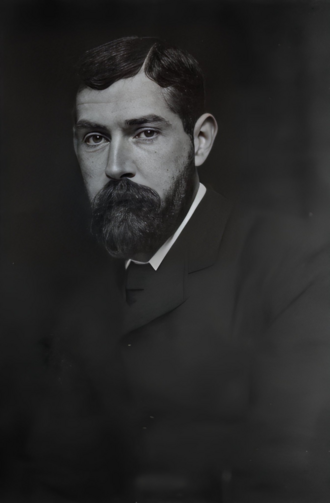
F. H. Bradley
1846–1924 · British idealist philosopher, leading exponent of absolute idealism
Francis Herbert Bradley (1846-1924) was a British philosopher and the leading figure of absolute idealism, a current rooted in Hegel that shaped much of English philosophy in the late nineteenth century. His major work, Appearance and Reality (1893), is regarded as one of the most original contributions to British metaphysics, blending Hegelian thought with a sharply personal critique of what human knowledge can claim.
He was born in Clapham, then in Surrey and now part of Greater London, into a family steeped in evangelical religion; his father was an Anglican preacher. He was educated at Cheltenham and Marlborough and, as a teenager, read part of Kant's Critique of Pure Reason. He entered Oxford in 1865 and in 1870 was elected to a fellowship at Merton College, where he remained until his death. A kidney ailment left him partly disabled, and for much of his life he wrote without teaching duties, which allowed him a quiet and highly individual output.
Bradley rejected pluralism. For him, reality forms a single whole that goes beyond the usual divisions between logic, metaphysics and ethics. He held that everything that exists is one global spiritual reality, which he called the Absolute, and that the categories we use to think about objects, science or even common sense are contradictory and fall short of full truth. Unlike Hegel, he argued that the finite human mind cannot grasp the Absolute adequately. In epistemology he maintained that facts are inferential and that none justifies a belief so firmly as to make it immune to revision. In his 1909 essay "On Truth and Coherence" he presented coherence as a test of truth rather than as an account of justification.
His influence was considerable in his day, but idealism lost ground after the attacks of Bertrand Russell and G. E. Moore. Today his work is being reassessed with renewed interest. T. S. Eliot wrote his doctoral dissertation at Harvard on him, and his thought left a mark on Eliot's poetry.
Key ideas
- Monism: reality is a unity that does not allow a strict division between logic, metaphysics and ethics.
- The Absolute: the totality of what exists, a spiritual reality that rises above every contradiction, though the finite mind cannot fully grasp it.
- Appearance and contradiction: the concepts we use to divide the world are incoherent and reveal only part of what is real.
- Coherence as a test of truth: instead of grounding knowledge in absolute certainties, truth is measured by the coherence of a system of beliefs.
- Inferential facts: facts, historical ones included, are conclusions of reasoning, and their validity depends on the correctness of that reasoning.
Curiosities
First British philosopher with the Order of Merit
He was the first British philosopher to receive the Order of Merit, a distinction recognising his intellectual standing.
A doctorate that was never completed
T. S. Eliot wrote his Harvard thesis on Bradley, but the war prevented his return for the oral defence, so the university never awarded the degree.
Teachers and influences
Influenced
- T. S. Eliot 1888–1965
Original Filopedia text based on Wikipedia (es) and Wikipedia (en) and Wikidata.