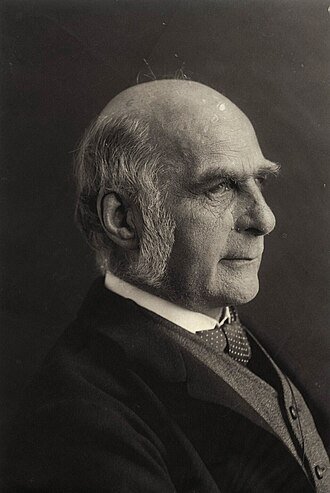
Francis Galton
1822–1911 · British polymath, statistician, anthropologist and eugenicist
Francis Galton (Sparkbrook, Birmingham, 1822 – Haslemere, Surrey, 1911) was a British polymath whose interests ranged from statistics and anthropology to psychology, meteorology, geography and exploration. He belongs to the Victorian tradition of applied science and the measurement of human nature, and he matters because he brought quantitative methods to the study of differences between people, a field previously dominated by qualitative observation. He published more than 340 papers and books, and his ideas still shape modern statistics, psychometrics and debates about heredity.
Galton was born near Birmingham into a family closely tied to Charles Darwin: they were half-cousins, sharing Erasmus Darwin as a grandfather. The Galtons were Quakers, gun manufacturers and bankers, and the household belonged to the orbit of the Lunar Society of Birmingham, where figures such as Priestley and Watt gathered. He showed remarkable precocity as a child. After leaving school at sixteen, he studied medicine for a time and then mathematics at Trinity College, Cambridge. A nervous breakdown disrupted his academic plans, and the death of his father in 1844 gave him financial independence, which he used for travel, sport and technical invention.
His career as an explorer brought him early fame. In 1850 he joined the Royal Geographical Society and, over two years, led an expedition into south-western Africa, now Namibia, whose experiences he described in a successful book. He also wrote The Art of Travel, a practical handbook for travellers that went through many editions. His cartographic work earned medals from geographical societies in London and Paris. The decisive turn, however, came with Darwin's On the Origin of Species in 1859, which led him to devote much of his life to studying variation in human populations.
In that field he devised new methods. To test whether ability was hereditary, he counted the relatives of eminent people and compared their numbers with those of the general population, setting out these results in Hereditary Genius (1869), a pioneering attempt to study genius scientifically. He used questionnaires and surveys to gather data, developed the concepts of correlation and regression toward the mean, and was among the first to frame the contrast between nature and nurture. His ideas also had a troubling social side: he held an elitist view and proposed encouraging the reproduction of those he deemed fittest, which gave rise to the term eugenics. That part of his work is now heavily criticised.
Galton was also a pioneer of meteorology, producing the first weather map published in The Times in 1875, and of criminology, with a method for classifying fingerprints that proved useful in forensic science. His influence endures in statistics, psychometrics and the study of behavioural genetics, though his legacy is marred by the racist and eugenic uses later drawn from his proposals.
Key ideas
- Correlation and regression toward the mean: statistical concepts describing the relationship between variables and the tendency of extreme values to move closer to the average over generations.
- Heritability of ability: the conviction that intelligence and talent were largely inherited, which he tried to demonstrate with genealogical data.
- Psychometrics: the quantitative measurement of mental faculties and of psychological differences between individuals.
- Eugenics: the proposal to improve the population by encouraging the reproduction of those considered fittest, with a strong elitist component.
- Nature versus nurture: the framing that contrasts the influence of heredity with that of environment in human development.
Works in Filopedia
- Hereditary Genius 1869
Books to read
- Inquiries into human faculty and its development EnglishEPUB 313 KBRead online
- Finger prints EnglishEPUB 234 KBRead online
- The art of travel : or, Shifts and contrivances available in wild countries EnglishEPUB 363 KBRead online
Curiosities
A child prodigy
According to his biographers, he was reading by the age of two and had moved on to adult books, including Shakespeare, by six.
The first weather map
The weather map he prepared appeared in The Times on 1 April 1875, and is now a standard feature of newspapers worldwide.
Teachers and influences
Influenced
- Lewis Terman 1877–1956
Original Filopedia text based on Wikipedia (es) and Wikipedia (en) and Wikidata.