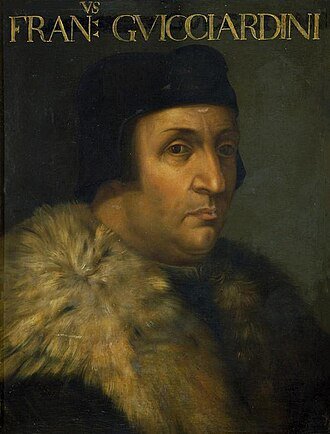
Francesco Guicciardini
1483–1540 · Florentine historian, statesman and Renaissance thinker
Francesco Guicciardini (Florence, 1483 – Arcetri, 1540) was a historian, statesman and thinker from Florence, and one of the leading figures of the Italian Renaissance. He belonged to the Florentine oligarchy and served the Medici and the papacy during years of foreign wars that tore the Italian peninsula apart. He is remembered above all for his History of Italy and for his sharp view of the politics of his age, which makes him an essential counterpart to Machiavelli.
His education was humanist and legal. He studied law in Ferrara and Padua and took his doctorate in civil law in 1505. His marriage to Maria Salviati in 1508 tied him to an influential family and opened the way to public life. In 1512 he was sent as ambassador to the court of Ferdinand the Catholic. There he watched Spanish armies and diplomacy at close range, and the experience produced his Relazione di Spagna, a shrewd analysis of the social and political conditions of the Iberian kingdoms.
After the return of the Medici, his career turned toward papal government. Under Leo X and then Clement VII he governed Modena, Reggio, Parma and the Romagna, and in 1521 he led the defence of Parma against the French. After the Sack of Rome in 1527 and the fall of the Medici in Florence, he was viewed with suspicion by the republicans and lost his property. He withdrew to his villas near the city, where he wrote his Considerations on Machiavelli's Discourses, in which he questioned his fellow citizen's gloomy outlook.
His major work, the History of Italy, covers the years 1494 to 1532 and gives a broad picture of the politics of the Italian states. Guicciardini presents himself as an impartial observer and a cool critic, and he explains the decisions of rulers through concrete interests rather than providential design. His political thought is realist. Where Machiavelli dreamed of a unified Italian state modelled on the European monarchies, Guicciardini saw the diversity of Italy's cities as a value that forced unity might destroy. His reliance on official documents also brings him close to modern historiography.
He spent his last years at Arcetri, putting his writings in order. Much of his unpublished work did not become known until the nineteenth century. Today he is regarded as a forerunner of modern historical writing and one of the great analysts of power in Renaissance Europe.
Key ideas
- Political realism: politics should be judged by real interests and forces, not by abstract ideals.
- Italian diversity: the cities and states of Italy have their own character, which a federal arrangement could preserve without imposed unity.
- Documented history: historical narrative should rest on official records and on direct observation of events.
- Criticism of the Church: the papacy and the Curia appear as sources of ambition and corruption, though the author acknowledges the practical ties that bound him to them.
Works in Filopedia
- Storie fiorentine 1859
Curiosities
A philosopher godfather
His father, Piero, had studied with the philosopher Marsilio Ficino, who became Francesco's godfather.
An ambassador at twenty-nine
He was sent to the Spanish court in 1512, so young that, as he wrote in his diary, no one in Florence could remember a man of his age being chosen for such an embassy.
A remark about Luther
He wrote that, were it not for the offices he had held under several popes, he would love Martin Luther as much as himself, in order to see that band of ruffians kept within its proper bounds.
Original Filopedia text based on Wikipedia (es) and Wikipedia (en) and Wikidata.