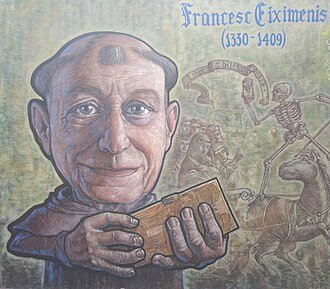
Francesc Eiximenis
1330–1409 · Franciscan Catalan writer, political thinker and moralist of the Crown of Aragon
Francesc Eiximenis (c. 1330-1409) was a Franciscan friar, probably born in Girona, although some sources place his birth in Barcelona. He belonged to the medieval scholastic tradition and is one of the most influential figures of Catalan literature of his age. Writing mostly in Catalan for a broad readership, he combined theology, ethics, politics and education.
He was trained in Franciscan schools and then studied at Oxford and Paris, where English thinkers such as Robert Grosseteste, Duns Scotus and William of Ockham shaped his outlook. In 1374 he earned his doctorate in theology at Toulouse, with the backing of King Peter IV. He spent most of his mature years in Valencia, where he advised the city's jurats and council and took part in social and educational affairs. He died in Perpignan in 1409.
His main project, Lo Crestià, was an encyclopedic vernacular summa of theology, of which only part was written. His most widely read texts include the Llibre dels àngels, the Llibre de les dones and the Life of Jesus Christ. His political thought, set out in the Regiment de la cosa pública, presents good government as a moral duty. His influence was considerable: his books were copied, translated and printed widely, and several circulated in Spanish, French and Latin.
Key ideas
- Good government as a moral duty: politics should aim at the common good and at the virtue of those who rule.
- Theology in the vernacular: religious learning should be accessible to laypeople, women and clergy alike.
- Contemplation and morality: spiritual life is linked to daily moral practice and the struggle against sin.
- Moderate theocracy: civil power is subordinated to Christian principles, in his view of society.
Where to start
Lo Crestià 1386
Lo Crestià is Eiximenis's great theological and didactic encyclopedia, written in Catalan between 1379 and 1392. It sets out in summary form the foundations of Christian faith and moral life in an accessible, instructive tone. It is the best entry point to understand his overall vision of knowledge and medieval society.
Next: Llibre de les dones. The Llibre de les dones, written around 1387, shows a closer and more practical Eiximenis, offering a view of the education and conduct of women in his time.
Works in Filopedia
- Tractat d'usura 1374
- Ars praedicandi populo 1379
- Lo Crestià 1386
- Llibre de les dones 1387
- Pastorale 1397
- Scala Dei 1399
- Vida de Jesucrist 1399
- Doctrina compendiosa 1400
- De triplici statu mundi 1400
- Cercapou 1400
- Psalterium alias Laudatorium 1404
- Summa theologica 1500
Curiosities
A large print run
The incunable edition of the Psaltiri devotíssim had about 2,000 copies, more than the two editions of Tirant lo Blanch combined.
First book printed in Granada
The Spanish translation of the Life of Jesus Christ was the first book printed in Granada, in 1496, after the city was conquered by the Catholic Monarchs.
Original Filopedia text based on Wikipedia (es) and Wikipedia (en) and Wikidata.