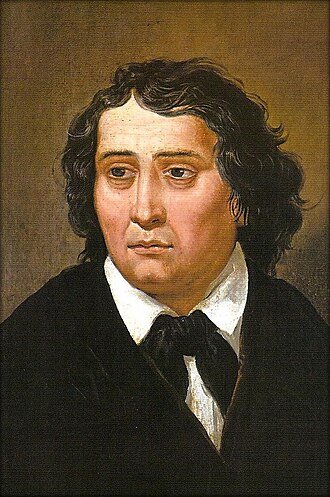
France Prešeren (1800–1849) was the most important poet in Slovene literature and one of the leading figures of European Romanticism. He lived under the Austrian Empire in Carniola, at a time when German was the language of schooling, administration and high culture across much of the Slovene lands. His work forms the core of the Slovene literary canon, and his importance lies in showing that Slovene could sustain poetry of the highest quality.
He was born in Vrba, in Upper Carniola, into a well-off farming family. He was the third of eight children and the eldest son. His unusually educated mother taught him to read and write and sent him early to uncles who were Catholic priests, hoping he would take holy orders; he never did. After schooling in Grosuplje and Ribnica, he moved to Ljubljana in 1812, where the poet Valentin Vodnik encouraged him to write in Slovene. In 1821 he enrolled at the University of Vienna to study law, reading widely in the classics, the Italian trecento poets and the Romantic writers of his own day.
His professional life was frustrating. After qualifying in 1828 he failed for years to win permission to practise as an independent lawyer, despite repeated applications, and worked as an assistant in a Ljubljana law firm. His lyric poetry grew out of these disappointments: his unrequited love for Julija Primic, the sense of a subjugated homeland, and his clashes with the civil, religious and provincial middle-class establishment of the city. He wrote mainly in Slovene, though also in German, and his style moved from early folk-inspired verse to the sonnets of his maturity, which he shaped on the advice of his friend Matija Čop. Severe alcoholism, suicide attempts and the tragic deaths of close friends marked his later years.
In 1846 he finally opened his own practice in Kranj, where he settled with his family and died in 1849. His legacy is considerable. His poems have been translated into many languages, and the motif of "hostile fortune" became a national myth in Slovene culture, especially after the Second World War. Once a provincial poet, he is now counted among the great names of European Romanticism.
Key works
- To Maidens (1827), a satirical poem on the brevity of youth, first published in German and Slovene.
- The Baptism on the Savica (1836), an epic-lyric poem dedicated to Čop about the forced Christianisation of the Carantanians.
- A Wreath of Sonnets (1834), his most important early work, uniting his unrequited love with the fate of a subjugated homeland.
- Sonnets of Misfortune (1834), six pessimistic sonnets reflecting on the poet's despair over life.
- Poems of Dr. France Prešeren (1847), a collection of his poems published in 1846 but dated 1847.
Curiosities
A poem regarded as the first Slovene ballad
In 1830 the almanac Krajnska čbelica published "The Water Man", which is considered the first Slovene ballad. It tells of Urška, a flirtatious young woman from Ljubljana.
A collection destroyed
In 1825 he showed a collection of Carniolan poems to the philologist Jernej Kopitar. Kopitar's harsh criticism led Prešeren to destroy nearly the whole collection.
Teachers and influences
Influenced by
- Johann Wolfgang von Goethe 1749–1832
- Virgil 69 BC–18 BC
- Friedrich Schiller 1759–1805
- Adam Mickiewicz 1798–1855
- Luís de Camões 1524–1580
- Friedrich Schlegel 1772–1829
Original Filopedia text based on Wikipedia (es) and Wikipedia (en) and Wikidata.