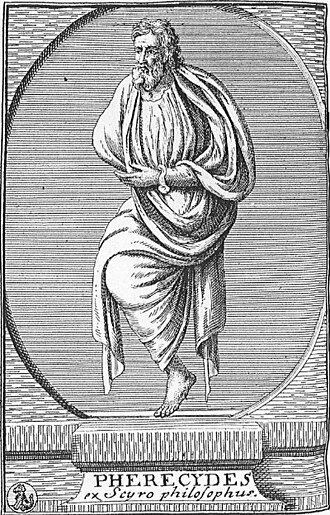
Pherecydes of Syros
579 BC–498 BC · Greek pre-Socratic philosopher from the island of Syros
Pherecydes of Syros was a Greek pre-Socratic thinker from the island of Syros in the Cyclades, active in the 6th century BCE. He is often counted among the first Greek writers to set out philosophical ideas in prose rather than verse, which places him between mythical thought and the philosophy that followed. Ancient tradition presents him as a teacher of Pythagoras and an older contemporary of Anaximander, although the sources disagree about his exact dates.
Little is known about his life. Some ancient writers included him among the Seven Sages of Greece, and he was said to have travelled widely, even to Egypt, though that journey is a stock detail in many philosophers' biographies. Stories credit him with remarkable predictions, such as an earthquake, a shipwreck and the fall of Messene, and his death is described in several contradictory ways.
His principal work, known as the Heptamychos or Pentemychos, is lost apart from a few fragments, including one from an Egyptian papyrus. It dealt with cosmogony, the origin of the universe, and theogony, the origin of the gods, and presented these ideas through mythic figures that he reshaped. Zas, meaning 'life', takes the place of Zeus as king of the gods; Chronos, or Time, generates the elements; and after a battle with the serpent Ophion, Chthonie becomes the Earth. Aristotle regarded him as one of the first to move beyond mythical explanation toward a systematic account of the world, though many later writers still called him a theologian.
His influence is most visible in later doxographers, who credited him with introducing the transmigration of souls into Greek religion, a doctrine later associated with Pythagoreanism and Orphism. Cicero and Augustine of Hippo also attributed to him the teaching of the immortality of the soul. Pherecydes thus links the mythology of Hesiod with pre-Socratic philosophy.
Key ideas
- Zas, the principle of life: the king of the gods, who replaces Zeus and orders the world after defeating Ophion.
- Chronos, time as origin: Time generates the elements and later withdraws from creative action.
- Rationalized mythic cosmogony: the gods are understood as forces and principles of the cosmos, not only as characters.
- Transmigration of souls: later doxographers credit him with introducing this doctrine, which influenced Pythagoreanism and Orphism.
Curiosities
A sundial on Syros
Diogenes Laertius noted that a sundial, or heliotropion, supposedly made by Pherecydes, was preserved on the island of Syros. The claim comes only from ancient testimony.
A warning at Messene
He is said to have warned his friend Perilaus that the city of Messene would be conquered. Similar prophetic stories are also told about legendary sages such as Pythagoras and Epimenides.
Teachers and influences
Pupils
- Pythagoras 582 BC–490 BC
- Anaximander 609 BC–545 BC
Influenced
- Pythagoras 582 BC–490 BC
Original Filopedia text based on Wikipedia (es) and Wikipedia (en) and Wikidata.