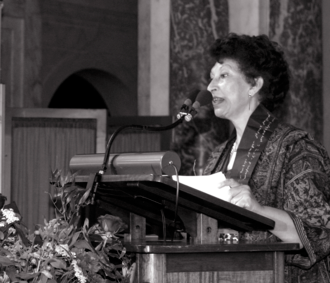
Fatema Mernissi
1940–2015 · Moroccan writer, sociologist and feminist
Fatema Mernissi (Fez, 1940 – Rabat, 2015) was a Moroccan writer, sociologist and feminist who wrote in Arabic, French and English. She is one of the best-known intellectuals of the contemporary Arab world and a key reference for anyone studying the relationship between Islam and women's rights. Her work matters because she questioned, from within the Islamic tradition and with the tools of sociology, the idea that female subordination was required by the Qur'an.
She was born in Fez in 1940 into a wealthy, traditional family. She grew up in the harem of the family house, a space shared by female relatives and servants, and her mother and grandmother were illiterate. Schooling became possible thanks to the rise of Moroccan nationalism, and she took full advantage of it. Until she was about twenty she spoke only Arabic, and then she learned other languages, which allowed her to study and publish beyond Morocco.
She studied political science at Mohammed V University in Rabat and, with a scholarship, continued at the Sorbonne in Paris. She earned her doctorate in sociology at Brandeis University in the United States in 1973, with a thesis later published as Beyond the Veil. Between 1973 and 1980 she taught sociology at the University of Rabat, and she later worked as a researcher at the University Institute for Scientific Research. She also worked as a consultant for international bodies such as UNESCO and the ILO.
Her work changed over the years. In the 1970s she argued that Muslim society needed deep change to challenge patriarchy and to rethink the place of Islam in modern life. Later, her writing turned toward social, political and religious reforms that would restore women's rights. Her research linking female literacy and birth rates in Morocco was pioneering, and her books on the Prophet and the women around him, especially The Veil and the Male Elite, made her controversial: it was banned in Morocco, though it was widely read in other Muslim countries.
In Dreams of Trespass she recalled, in the form of a memoir, her childhood in the harem of Fez, where women had no access to the outside world and she learned to imagine other worlds. Her legacy is twofold. As a scholar, she produced rigorous sociological studies of Islam and women. As a public voice, she gave shape to Islamic feminism, which insists that emancipation does not require abandoning faith. She received the Prince of Asturias Award in 2003, and her ideas remain central to debates on gender, religion and citizenship in the Arab world and beyond.
Key works
- Beyond the Veil: Male-Female Dynamics in Modern Muslim Society (1975): her doctoral thesis, based on interviews and letters from Moroccan women, examining the tension between official Islam and gender equality.
- The Veil and the Male Elite: A Feminist Interpretation of Women's Rights in Islam (1987): a quasi-historical study of the wives of the Prophet Muhammad, banned in Morocco.
- Dreams of Trespass: Tales of a Harem Girlhood (1994): a fictionalized memoir of her childhood in a harem in Fez.
- The Forgotten Queens of Islam (1993): an examination of the political roles women played in early Islamic history.
- Women's Rebellion and Islamic Memory (1996): an analysis of women's place in contemporary Islam, the economy and the state.
Curiosities
A banned book
*The Veil and the Male Elite* was the only one of her books banned in Morocco. It was, however, very successful in other Muslim countries, such as Syria.
A thesis that became a classic
Her doctoral thesis, published in 1975, became a standard reference in sociology and in studies of the Arab and Muslim worlds.
Original Filopedia text based on Wikipedia (es) and Wikipedia (en) and Wikidata.