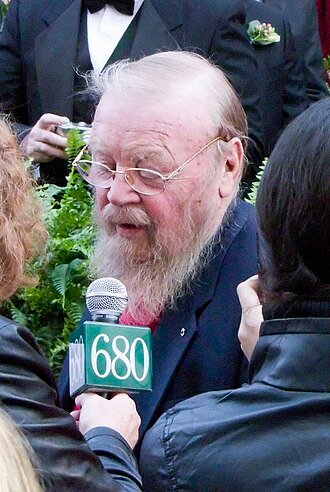
Farley Mowat
1921–2014 · Canadian writer and environmentalist
Farley Mowat (Belleville, 1921 - 2014) was a Canadian writer and environmentalist who wrote in English. His books about the Canadian north and its peoples made him one of the most widely read voices in the country during the second half of the twentieth century, and his work was translated into 52 languages.
He grew up in Richmond Hill, Ontario, and as a teenager in Saskatoon he wrote about birds and produced a small nature newsletter. He studied zoology at the University of Toronto but never completed a degree. During the Second World War he served in the Canadian Army in Sicily, Italy and the Netherlands. The emotional aftermath of fighting in Italy stayed with him for years, and his intelligence work in the Netherlands helped arrange the food drops that saved thousands of lives at the war's end.
After the war he worked as a field assistant on studies of barren-ground caribou, and that experience shaped his first books. His debut, People of the Deer (1952), grew out of an Arctic expedition and protested the living conditions of the Inuit. His style mixes poetic description, vivid imagery and a moral outrage that never hides his strong likes and dislikes. He also wrote autobiographical books such as And No Birds Sang, about the war, and children's stories such as Lost in the Barrens, which won a Governor General's Award.
His account of Arctic wolves, Never Cry Wolf (1963), became his most popular book and was adapted into a film in 1983. When he admitted that some of his books' claims were not accurate, he faced harsh criticism. His supporters argue that his exaggerations drew attention to the plight of the Inuit and to environmental problems, with effects on federal policy. His legacy lies in that double reading: an author whose writing of protest sparked public debate about the accuracy of his texts and about the responsibility of the writer as an activist.
Key works
- People of the Deer (1952), his first book, about Inuit life in the Canadian north.
- Lost in the Barrens (1956), a children's survival story set in the north, which won a Governor General's Award.
- Never Cry Wolf (1963), an account of his experiences with Arctic wolves, later adapted into a 1983 film.
- And No Birds Sang (1979), a memoir of his experience fighting in Italy during the Second World War.
Where to start
Never Cry Wolf 1963
Wolves Don't Cry is a first-person autobiographical account in which Mowat recounts his observations of Arctic wolves in the Canadian subarctic. It blends field chronicle with reflection on the relationship between humans and nature, showing his environmental sensibility in a direct and accessible way for any reader.
Next: The Curse of the Viking Grave. The Curse of the Viking Grave is a youth adventure that continues the story of Lost in the Barrens and broadens its view of the Canadian North, its landscapes and its peoples.
Works in Filopedia
Curiosities
From nature newsletter to army
As a teenager in Saskatoon he wrote a column about birds for a local newspaper and produced his own nature newsletter, Nature Lore.
A law that was overturned
In 1985 customs agents at Toronto's Pearson airport denied him entry to the United States under a law that allowed the refusal of alleged Communist sympathizers. The law was overturned in 1990, and Mowat recounted the episode in My Discovery of America.
Original Filopedia text based on Wikipedia (es) and Wikipedia (en) and Wikidata.