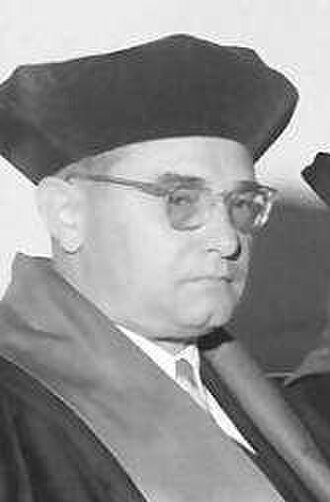
Eugen Fink
1905–1975 · German philosopher of phenomenology
Eugen Fink (Konstanz, 1905 – Freiburg im Breisgau, 1975) was a German philosopher and one of the major figures of phenomenology. His significance lies in extending phenomenology toward ontology and cosmology, and in being a close witness to the sometimes strained relationship between Edmund Husserl and Martin Heidegger.
He studied philosophy, history, German and economics at Münster, Berlin and Freiburg. In 1928 he became Husserl's assistant, and in 1933 he chose to serve as Husserl's private secretary rather than pursue an academic career. He helped prepare Husserl's texts, and after the war he earned his habilitation at Freiburg in 1946. From the founding of the Husserl Archives there in 1950 until his retirement in 1971, he directed them.
His most debated work is the Sixth Cartesian Meditation, written to complete Husserl's Cartesian Meditations. It was not published until 1988. Husserl disagreed with several of its claims, above all Fink's sharpened distinction between the anonymous transcendental ego and the reflective ego of the phenomenologist. Over time Fink moved away from phenomenology, questioning whether the transcendental reduction could work, and developed a reflection on being as a manifestation of cosmic movement in which humans take part. His writings on play, education and Nietzsche round out a body of thought that left its mark on philosophical anthropology and pedagogy.
Key ideas
- Reduction and epoché: the phenomenologist suspends beliefs about the world, though Fink argues that a person cannot fully disconnect from himself while carrying out that suspension.
- The three egos: he distinguishes the anonymous transcendental ego, the object of phenomenology, from the reflective ego of the phenomenologist who observes it.
- Play as a symbol of the world: play is not a trivial activity but a way of representing and grasping the whole of the world.
- Cosmology: the question of being is understood as a manifestation of cosmic movement in which human beings participate.
Curiosities
Husserl's private secretary
In 1933 he chose to become Husserl's private secretary instead of pursuing an academic career, and he helped prepare Husserl's texts.
A meditation published decades late
The Sixth Cartesian Meditation, written to complete Husserl's, was not published until 1988.
Teachers and influences
Teachers
- Edmund Husserl 1859–1938
Original Filopedia text based on Wikipedia (es) and Wikipedia (en) and Wikidata.