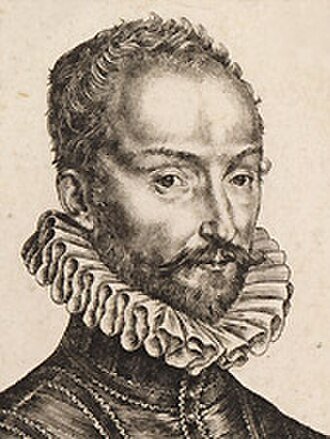
Étienne Jodelle
1532–1573 · French poet and dramatist of the Renaissance
Étienne Jodelle (Paris, 1532 – Paris, July 1573) was a French poet and dramatist of the Renaissance and a member of La Pléiade. Born and dead in Paris, into a family of the urban bourgeoisie, he wrote in French and is remembered for trying to bring the models of Greek and Roman antiquity back to the stage. For that reason he is seen as a forerunner of French classical theatre.
His family belonged to the Parisian middle class, yet Jodelle always seems to have been drawn toward the nobility, and he came to be known as seigneur de Limodin after his father died when he was only four. His mother raised the children, and an maternal uncle who owned a large library probably awakened his love of literature. He spent time in Lyon around 1550 and then settled in Paris, where he befriended Baïf, Denisot and Belleau and moved in the circle of the patron Jean II Brinon.
In 1553 his tragedy Cleopatra captive and his comedy Eugène were performed before King Henry II. The tragedy was the first humanist tragedy in French and the first to use the alexandrine line in that genre. According to tradition, the first performance was marked by a rite with pagan echoes at Arcueil, which the enemies of the Ronsardists later blew up into a cult of Bacchus. Dido se sacrifiant, written around 1555, drew on the story in Virgil's Aeneid.
His fortunes declined in 1558, when a spectacle commissioned by the Paris city authorities to celebrate the capture of Calais turned into a fiasco. A death sentence is said to date from around this time, though the evidence is unclear. He wrote sonnets against the Protestant ministers, but was later accused of defending the St Bartholomew's Day massacre. He received a sum from Charles IX in 1572, yet he remained in debt and died in poverty in July 1573.
His reputation grew mostly after his death. Charles de La Mothe published his works in 1574, and the Protestant poet Agrippa d'Aubigné wrote funeral verses for him. Modern scholars value him as a precursor of French theatre and as a forerunner of what would later become classical tragedy.
Key works
- Cléopâtre captive (1553): a humanist tragedy modelled on antiquity, in which the action is mostly narrated and commented on by moralising choruses rather than staged.
- L'Eugène (1553): a comedy that satirises the higher clergy.
- Didon se sacrifiant (c. 1555): a tragedy drawing on the story told in Virgil's Aeneid.
Works in Filopedia
Curiosities
A garlanded goat
After the premiere of his tragedy, Jodelle and his friends reportedly held an ancient-style ceremony at Arcueil, in which a goat decked with flowers was led in procession to the author.
A death in poverty
Despite receiving five hundred pounds from King Charles IX in 1572, Jodelle kept falling into debt and died in July 1573 in a hovel on the rue Champ-Fleury.
An asteroid named after him
The asteroid (317917) Jodelle was named in his honour.
Teachers and influences
Teachers
- Muretus 1526–1585
Original Filopedia text based on Wikipedia (es) and Wikipedia (en) and Wikidata.