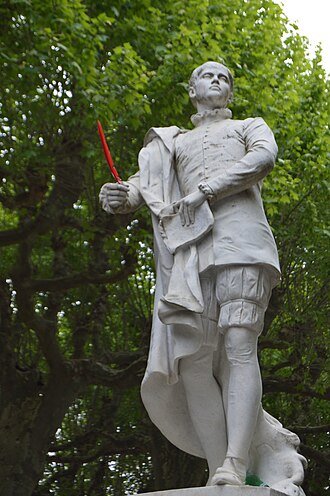
Étienne de La Boétie
1530–1563 · French magistrate, humanist and political thinker of the Renaissance
Étienne de La Boétie (Sarlat, 1530 - Germignan, near Bordeaux, 1563) was a French magistrate, humanist and political thinker. He held a respected place in the legal circles of Bordeaux and is remembered above all for a short text against tyranny and for his friendship with Michel de Montaigne. His work belongs to the humanism that revived the classics of Greece and Rome, and his political ideas still feature in debates about obedience and peaceful resistance.
He was born into an aristocratic family in the Périgord region. Orphaned at an early age, he was raised by an uncle who shared his name. He studied law at the University of Orléans and in 1553 was appointed a councillor of the Parlement of Bordeaux, even though he was below the minimum age for the post. There he built a career as a judge and negotiator. He was also a poet and a translator of Xenophon and Plutarch, and he moved in the circle of the young poets of the Pléiade.
His best-known work, the Discourse on Voluntary Servitude, asks a simple but unsettling question: why do so many people accept being ruled by one man? In his view, a tyrant has no power of his own. He holds only the power that the people hand over to him, so consent matters more than force. The remedy he proposes is not armed confrontation but withdrawing support. The text circulated privately and was published only after his death, and the date of its composition is still debated. He draws on many examples from antiquity, which let him criticise the politics of his own time under a cover of scholarship.
In the 1560s he took part, alongside Michel de L'Hospital, in negotiations to secure civil peace during the Wars of Religion, arguing for tolerance and reconciliation. His friendship with Montaigne was deep, and Montaigne remembered it in one of his essays on friendship. La Boétie died in 1563, at the age of thirty-two, from the plague at Germignan.
His influence has been considerable. The Huguenots made use of his text, and in the twentieth century it was cited by anarchists such as Gustav Landauer and Simone Weil, and by theorists of nonviolent struggle such as Gene Sharp. Although he served public order throughout his career, he is regarded as an intellectual forerunner of civil disobedience.
Key ideas
- Consent: the tyrant's power rests on the obedience of those who sustain him.
- Voluntary servitude: people submit out of habit, fear or self-interest, and for that reason they can stop submitting.
- Withdrawing support: peaceful resistance means refusing obedience rather than taking up arms.
- Tolerance: he argued for religious peace and coexistence between Catholics and Protestants.
Works in Filopedia
Curiosities
An early appointment
He became a councillor of the Parlement of Bordeaux in 1553, although he was not yet old enough to meet the minimum age for the post.
An essay on friendship
Montaigne immortalised him in one of his essays on friendship, which is the main source of what we know about their bond.
Original Filopedia text based on Wikipedia (es) and Wikipedia (en) and Wikidata.