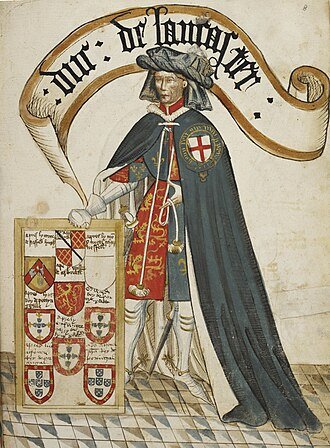
Henry of Grosmont, 1st Duke of Lancaster
1310–1361 · English nobleman, soldier and diplomat
Henry of Grosmont (c. 1310-1361) was an English nobleman who moved between warfare, diplomacy and politics under King Edward III. He lived in the England of the Plantagenets, in the early years of the Hundred Years' War, and he matters because he was the first Duke of Lancaster and one of the founding members of the Order of the Garter. His world was multilingual: the nobility of his day spoke Anglo-Norman, Old French and Middle English.
He was the only son of Henry, 3rd Earl of Lancaster, and Maud Chaworth, and he inherited the earldoms of Lancaster, Leicester and Derby on his father's death. He distinguished himself at the Battle of Auberoche and became one of Edward III's most trusted captains. In 1348 he was a founding member of the Order of the Garter. His diplomatic efforts produced a brief but significant peace with France, which earned him the king's favour, since the king was his cousin. In 1351 his earldom of Lancaster was raised to a dukedom. He had married Isabel de Beaumont in 1334, and they had two daughters, Maud and Blanche, who later inherited his titles. He died at Leicester in 1361, a victim of the plague.
He was also the author of Livre de Seyntz Medicines, a highly personal devotional treatise that shows a reflective side rare in a nobleman of his age. His most lasting legacy may be his role, with others, as a founder and early patron of Corpus Christi College, Cambridge, established in 1352 by two town guilds. That connection keeps his name attached to one of the oldest university institutions in England.
Key works
- Livre de Seyntz Medicines, a highly personal devotional treatise.
Curiosities
A late start in reading
According to the sources, he did not learn to read until later in life, although he was more skilled in martial arts than in academic subjects.
Death from the plague
He died at Leicester in 1361, a victim of the plague epidemic that struck Europe in those years.
Original Filopedia text based on Wikipedia (es) and Wikipedia (en) and Wikidata.