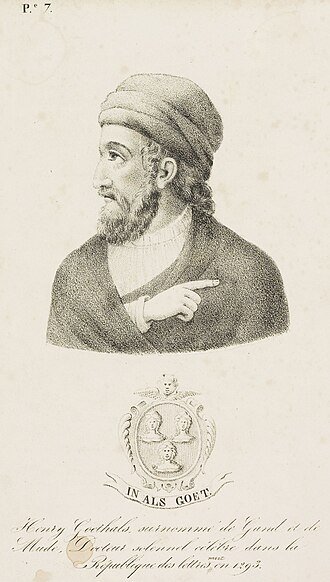
Henry of Ghent
1217–1293 · Medieval scholastic philosopher and theologian
Henry of Ghent (c. 1217-1293) was one of the leading philosophers and theologians of thirteenth-century scholasticism, later known as the Doctor Solemnis. His work sits between the reception of Aristotle and a strong Platonic and Augustinian current, which makes him a key figure for understanding the intellectual debates in Paris in the second half of that century.
Born in the region of Ghent, he studied there and in Cologne under Albertus Magnus. After earning his doctorate he returned to Ghent, where he is said to have been the first to lecture publicly on philosophy and theology. He later settled in Paris, where he became a regent master and was drawn into the disputes between the mendicant orders and the secular clergy, siding with the latter. He had a hand in the propositions condemned in 1277 and was called to answer for it. His controversy over the repetition of confession, which set secular priests against friars, occupied much of his life.
In philosophy he defended divine illumination as the main route to knowledge of God and the existence of universals in the divine mind. He distinguished between essence and actual existence and proposed the intentional distinction, a middle ground between a purely logical and a real distinction. His standards for scientific certainty were stricter than those of Thomas Aquinas, a point Duns Scotus later contested. His influence passed mainly through his students and through the later debate over Scotus's formal distinction.
Key ideas
- Being of essence: before it exists, each thing has an essence that God creates and that is later actualized in existence.
- Intentional distinction: one and the same reality can be expressed by different concepts without being a purely logical or a real distinction.
- Illumination: knowledge of God depends on divine illumination, and exemplary ideas exist in the divine mind.
- Scientific certainty: only what is certain, necessary and demonstrated by syllogism counts as true knowledge.
Curiosities
Doctor Solemnis
He later received the nickname Doctor Solemnis, by which he is known ever since.
A disputed origin
He is supposed to have belonged to an Italian family named Bonicolli, though the question of his name remains debated.
Teachers and influences
Teachers
- Albertus Magnus 1200–1280
Original Filopedia text based on Wikipedia (es) and Wikipedia (en) and Wikidata.