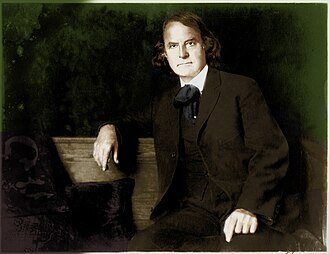
Elbert Green Hubbard
1856–1915 · American writer, publisher and philosopher, a leading figure of the Arts and Crafts movement
Elbert Hubbard (1856–1915) was an American writer, publisher, artist and philosopher, best known as a leading figure of the Arts and Crafts movement, which championed handmade work at a time of mass production. Today he is remembered mainly for the artisan community he founded in East Aurora, New York, and for A Message to Garcia, a short essay that has been read for more than a century as a tribute to personal initiative.
Born in Bloomington, Illinois, to a physician, Silas Hubbard, he grew up in Hudson, where the family moved after a short stay in Bloomington. His first job was as a traveling salesman for the Larkin Soap Company, a career that took him to Buffalo, New York, and taught him the arts of persuasion and promotion. Only later did he devote himself fully to writing and publishing.
In 1895 he founded Roycroft in East Aurora. The community grew out of the Roycroft Press, a small private press inspired by William Morris's Kelmscott Press. Its workshops printed books on handmade paper and also worked in bookbinding, furniture, tooled leather and hammered copper, becoming a leading producer of Mission style goods. Hubbard also edited two magazines, The Philistine, a satirical and provocative periodical, and The FRA. Roycroft hosted gatherings of radicals, freethinkers, reformers and suffragists, and his second wife, Alice Moore Hubbard, was a noted suffragist.
His views shifted over the years. He began with a homespun socialism shaped by Morris, later became a defender of free enterprise and American practical know-how, and in his writings called himself an anarchist and a socialist, aiming at social, economic and spiritual freedom. His credo in A Message to Garcia and Thirteen Other Things named Ruskin, Morris, Thoreau, Whitman and Tolstoy as prophets, and in Jesus Was an Anarchist (1910) he criticized war, law and government. His most ambitious project was Little Journeys to the Homes of the Great, fourteen volumes of sketches of notable figures.
Hubbard and his wife died in May 1915 when the RMS Lusitania was torpedoed and sunk by the German submarine U-20 off the Irish coast. His end seemed to follow the pattern he had admired in Ida Straus, who refused to leave her husband on the Titanic. Roycroft continued under his son, Elbert Hubbard II, until 1938, and his name endures in the ideal of work done well by hand.
Key ideas
- Initiative and responsibility: in A Message to Garcia he argues that those who carry out a task without constant supervision are the most valuable.
- Handmade work: Roycroft held that an object made by hand, with care and purpose, was a form of dignity against mass production.
- From socialism to free enterprise: he began with a Morris-inspired socialism and ended defending the market and American practical ingenuity.
- Total freedom: he championed social, economic, political and spiritual liberty, and called himself an anarchist in his writings.
- Critique of authority: in Jesus Was an Anarchist he questioned war, law and the state as institutions that constrain the individual.
Books to read
- Little Journeys to the Homes of the Great - Volume 11 Little Journeys to the Homes of Great Businessmen EnglishEPUB 314 KBRead online
- A Message to Garcia Being a Preachment EnglishEPUB 83 KBRead online
- Little Journeys to the Homes of the Great Philosophers, Volume 8 EnglishEPUB 296 KBRead online
- Little Journeys to the Homes of the Great - Volume 13 Little Journeys to the Homes of Great Lovers EnglishEPUB 301 KBRead online
- Love, Life & Work Being a Book of Opinions Reasonably Good-Natured Concerning How to Attain the Highest Happiness for One's Self with the Least Possible Harm to Others EnglishEPUB 136 KBRead online
- Little Journeys to the Homes of the Great - Volume 01 Little Journeys to the Homes of Good Men and Great EnglishEPUB 261 KBRead online
- Little Journeys to the Homes of the Great - Volume 05 Little Journeys to the Homes of English Authors EnglishEPUB 244 KBRead online
- Little Journeys to the Homes of the Great - Volume 10 Little Journeys To The Homes Of Great Teachers EnglishEPUB 265 KBRead online
- Little Journeys to the Homes of the Great - Volume 14 Little Journeys to the Homes of Great Musicians EnglishEPUB 361 KBRead online
Curiosities
A butcher-paper cover
The Philistine was bound in brown butcher paper. Hubbard joked that this was because "there is meat inside."
A quote wrongly credited to Aristotle
The line "Do nothing, say nothing, and be nothing, and you'll never be criticized" is often attributed to Aristotle, but it comes from Hubbard's biography of the automotive developer John North Willys.
A quote in fiction
Mack Bolan, the hero of Don Pendleton's The Executioner series, often cites a Hubbard line: "God will not look you over for medals, diplomas, or degrees, but for scars."
Original Filopedia text based on Wikipedia (es) and Wikipedia (en) and Wikidata.