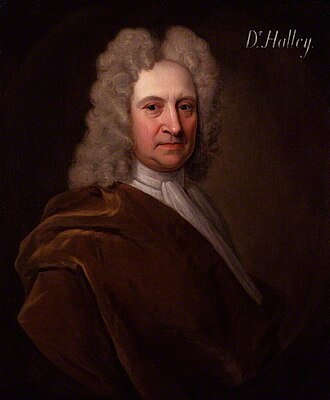
Edmond Halley
1656–1742 · English astronomer, mathematician and physicist, second Astronomer Royal
Edmond Halley (1656-1742) was an English astronomer, mathematician and physicist, best remembered for calculating the orbit of the comet that bears his name. He belonged to the generation that, after Copernicus, Kepler and Galileo, helped establish modern astronomy on the foundations of physics and mathematics. His significance lies both in his specific achievements and in his role as a bridge between observers and theorists in the England of the Royal Society.
The son of a wealthy London soap-maker, he studied at St Paul's School and then at The Queen's College, Oxford, where he published papers on the Solar System and sunspots. Around 1676 he sailed to the island of Saint Helena to catalogue the southern sky, a hemisphere that had been poorly observed until then. There he recorded a transit of Mercury and realised that a transit of Venus could be used to work out, by trigonometry, the distances between Earth, Venus and the Sun. Back in England he published a catalogue of 341 southern stars, was elected to the Royal Society and later served as its secretary.
His friendship with Isaac Newton proved decisive. In 1684 Halley went to Cambridge to ask about planetary orbits and found that Newton had already solved the problem. Halley pressed him to publish, and he paid for the first edition of the Principia Mathematica (1687). Applying Newton's laws of motion and gravitation to observations of a comet seen in 1682, he calculated its orbit and argued that it matched the appearances of 1531 and 1607. He predicted its return in 1758, which he did not live to see, and the comet was named after him.
Halley also worked on terrestrial magnetism, with sea voyages from 1698 that produced one of the first charts of magnetic declination, and on meteorology. In 1686 he attributed atmospheric motion to solar heating and linked barometric pressure to altitude. In 1718 he detected the proper motion of certain stars, which had not been noticed before. He became the second Astronomer Royal in 1720, succeeding John Flamsteed at the Greenwich Observatory, and held the post until his death.
His influence reaches astronomy, geophysics and applied statistics. His mortality tables, based on Breslau records, helped lay the groundwork for actuarial science. Halley is remembered as a scientist who combined careful observation with Newtonian theory and who turned a mathematical prediction into a public test of Newton's physics.
Key ideas
- Cometary orbits: comets move in elliptical orbits governed by gravitation, and some return with a calculable period.
- Solar parallax from transits: observations of transits of Venus allow the distances within the Solar System to be calculated trigonometrically.
- Mapping terrestrial magnetism: variations in magnetic declination can be shown on charts using isogonic lines.
- Proper motion of stars: so-called fixed stars drift slowly across the sky, which Halley detected by comparing old and new star positions.
- Mortality tables: analysing age at death allows fair prices to be set for life annuities.
Curiosities
A comet bearing his name
The comet was observed in 1682, and Halley predicted its return in 1758. It came back as foreseen, though he did not live to see it.
A voyage to map the south
To observe the southern sky he set up on the island of Saint Helena, from where he compiled his catalogue of 341 stars.
Teachers and influences
Teachers
- Robert Hooke 1635–1703
Original Filopedia text based on Wikipedia (es) and Wikipedia (en) and Wikidata.