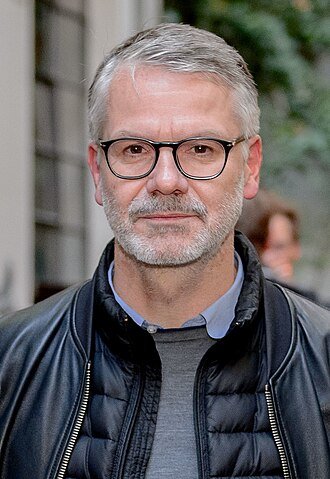
Durs Grünbein (born in Dresden, 1962) is a German poet and essayist whose work, written in German, moves between the end of East Germany, the relationship between poetry and science, and the legacy of classical antiquity. His career offers a window onto how German-language literature reinvented itself after reunification.
He grew up in Dresden and studied theatre in East Berlin, moving there in 1985. After the peaceful revolution of 1989 brought down the Berlin Wall and the communist regime of the GDR, he travelled widely through Europe, South-West Asia and North America, staying for periods in cities such as Amsterdam, Paris and Los Angeles. He lives in Berlin and, since 2013, also in Rome.
His early poetry collections, such as Grauzone morgens and Schädelbasislektion, combine life in the East with an interest in the links between literature and the natural sciences. From the late 1990s, with Nach den Satiren, classical antiquity came to play a larger role in his poems and essays, which blend autobiography, history and ethical reflection. His output also includes prose, aphorisms, diaries and three opera libretti, and he has translated authors such as Aeschylus, Seneca and Samuel Beckett.
Grünbein won the Georg Büchner Prize in 1995, Germany's most prestigious literary honour, and was later recognised with numerous other awards. His legacy lies in combining a deeply learned poetry with a sustained attention to the present, and in having his work translated into many languages.
Key works
- Schädelbasislektion (1991), a collection on scientific and existential themes shaped by life in the East.
- Nach den Satiren (1999), a book in which classical antiquity takes a central place in his poetry.
- Erklärte Nacht (2002), a collection of poems from his mature period.
- Galilei vermisst Dantes Hölle und bleibt an den Maßen hängen (1996), essays on science, history and literature from 1989 to 1995.
- Porzellan. Poem vom Untergang meiner Stadt (2005), a poem on the destruction of Dresden in 1945.
Curiosities
A prize with two possible years
The record links the Tomas Tranströmer prize to both 2002 and 2012, so the date should be taken with caution.
An opera in Vienna
His third opera premiered at the Wiener Staatsoper on 8 December 2018, with music by the Austrian composer Johannes Maria Staud.
Original Filopedia text based on Wikipedia (es) and Wikipedia (en) and Wikidata.