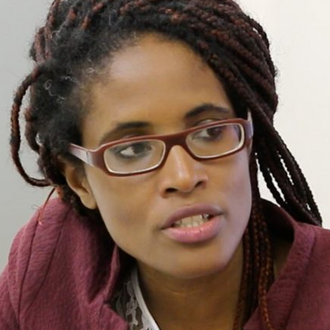
Djamila Ribeiro
b. 1980 · Brazilian feminist philosopher, journalist and activist
Djamila Ribeiro (born in Santos, 1980) is a Brazilian philosopher, journalist and activist, and one of the leading voices of Black feminism in her country and abroad. Her work, rooted in political philosophy, examines racism, gender and class from the standpoint of Black women, and it has shaped public debate in Brazil and well beyond.
The daughter of a dockworker and a domestic worker, Ribeiro started working young and studied alongside her jobs. After her parents died of cancer, she left her journalism degree, and later enrolled in philosophy at the Federal University of São Paulo (UNIFESP), where her undergraduate thesis examined Simone de Beauvoir and Judith Butler. Since 2019 she has written a weekly column for the newspaper Folha de S. Paulo.
Her best-known book, Lugar de Fala, argues that everyone speaks from a particular social position, and that this position shapes whose voices are heard. Building on that idea, she calls for Black women to speak for themselves rather than be spoken about. Her other books, including Quem tem medo do feminismo negro? and Pequeno manual antirracista, bring these ideas to a wide readership. The latter was Brazil's best-selling book in 2020.
Ribeiro also coordinates the Plural Feminisms Collection, which has published many Black authors, and founded the Espaço Feminismos Plurais in São Paulo to support socially vulnerable women. Her influence lies in spreading Brazilian Black feminist thought, in the translation of her work into several languages, and in her visiting professorships at MIT and NYU.
Key ideas
- Place of speech: every statement comes from a specific social position, and acknowledging it is essential to an honest debate.
- Intersectionality: race, gender and class intersect to produce distinct forms of oppression that cannot be analysed separately.
- Black feminism: Black women have been excluded from both antiracist and feminist discourse, and need a theory of their own.
- Everyday antiracism: racism is not only an individual matter but a structure reproduced through institutions, language and routine practices.
Curiosities
A name with meaning
Djamila means «beautiful» in both Arabic and Swahili. Her father chose the name from a newspaper of the Black movement.
First column
Her debut piece in Folha de S. Paulo, published in June 2019, was titled «Sorry, Whitney», a tribute to her love of Whitney Houston.
Original Filopedia text based on Wikipedia (es) and Wikipedia (en) and Wikidata.