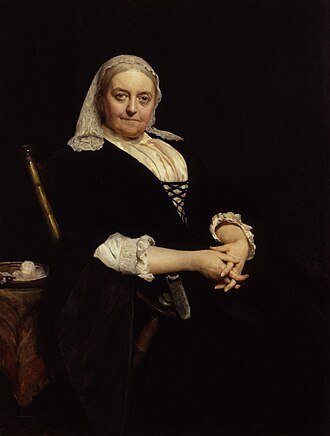
Dinah Craik
1826–1887 · English novelist and poet
Dinah Maria Craik, born Dinah Maria Mulock, was an English novelist and poet who wrote during the Victorian era, mainly between the 1840s and the 1880s. She began with children's stories and became one of the most widely read novelists of her time. Her best-known book, John Halifax, Gentleman, portrays the ideals of English middle-class life and secured her a place among the leading women novelists of her day.
She was born on 20 April 1826 at Stoke-upon-Trent, the daughter of Thomas Mulock, an evangelical minister of Irish descent whose unsettled fortunes and fragile mental health shaped her early years. The family lived in Newcastle-under-Lyme, Staffordshire, and she gained a good education from several sources. In 1839 she moved with her family to London, where she studied design and languages. After her mother died in 1845 she took on the running of the household and the care of her brothers. Her literary career truly began around 1847, helped by friends such as Alexander Macmillan. She first wrote stories for young readers, such as Cola Monti (1849), and that same year published her first novel, The Ogilvies.
In the decades that followed she produced novels, stories, poems and essays. Her early fiction is marked by emotional force and examines the romantic and married lives of Victorian society. A Life for a Life (1859), an epistolary novel, earned more money and was perhaps more widely read than John Halifax at the time, though it did not win the same lasting reputation. Her later work grew more didactic, and her essays and sermons drew more notice than her final novels. Late in her career she returned to fantastic tales with The Little Lame Prince (1874), which became one of her greatest successes. Her poems, gathered in 1881, have a tender, domestic tone, and some, such as "Douglas, Douglas, Tender and True", became widely popular.
In 1865 she married George Lillie Craik, a partner in the publishing house Macmillan, and they settled at Shortlands near Bromley. They adopted a baby girl, Dorothy, in 1869, and Craik balanced family life with a writing career she never gave up. She died on 12 October 1887, while preparing for her daughter's wedding. Her legacy rests chiefly on John Halifax, Gentleman and her books for children, which are still read as examples of Victorian middle-class fiction.
Key works
- John Halifax, Gentleman (1857): a novel about a poor young man's rise in mid-Victorian middle-class England, her most representative work.
- A Life for a Life (1859): an epistolary novel about two people shaped by a crime of passion and an unmarried motherhood.
- Cola Monti (1849): an early children's story with which her literary career began.
- The Little Lame Prince (1874): a fantasy tale for children and one of her greatest late successes.
Where to start
John Halifax, Gentleman is an accessible novel that represents much of Craik's work. It tells the story of an orphan who, through honest labour and perseverance, becomes a prosperous manufacturer during the British Industrial Revolution. The reader will find an engaging account of effort, dignity and the moral values of the Victorian age.
Next: The Little Lame Prince and his Travelling Cloak. The Crooked Prince and His Magic Cloak shows another side of the author, children's fantasy, revealing her lighter imagination.
Works in Filopedia
Books to read
- Olive: A Novel EnglishEPUB 403 KBRead online
- Agatha's Husband: A Novel EnglishEPUB 396 KBRead online
- The Little Lame Prince and His Travelling Cloak EnglishEPUB 161 KBRead online
- The Fairy Book The Best Popular Stories Selected and Rendered Anew EnglishEPUB 352 KBRead online
- The Little Lame Prince EnglishEPUB 173 KBRead online
- The Little Lame Prince Rewritten for Young Readers by Margaret Waters EnglishGutenberg
Curiosities
A late marriage
Unmarried for many years, she wed George Lillie Craik, a partner in the publisher Macmillan, in 1865, at the age of thirty-nine.
An adopted daughter
Four years after their marriage, the couple adopted an abandoned baby girl, Dorothy, whom they called "the gift of heaven".
Original Filopedia text based on Wikipedia (es) and Wikipedia (en) and Wikidata.