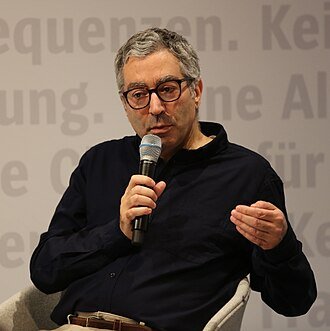
Didier Eribon
b. 1953 · French philosopher and historian of intellectual life
Didier Eribon (born in Reims in 1953) is a French philosopher and a historian of his country's cultural and intellectual life. He is associated with work on identity, social class and sexuality, and his writing has reached well beyond the university. He lives in Paris.
Born into a working-class family in Reims, he was the first in his family to complete secondary school, an achievement he credits largely to his mother, a factory worker who took on overtime to pay for his education. He studied philosophy in Paris and for several years has led seminars at the École des hautes études en sciences sociales. He has taught at the University of Amiens and as a visiting professor at the University of California, Berkeley, and has lectured at American institutions including Harvard, Yale and The New School.
Among his best-known works are his book-length interviews with Georges Dumézil and Claude Lévi-Strauss, and above all his biography of Michel Foucault (1989), which quickly appeared in several languages. In books such as Reflections on the Gay Question (1999) and Une morale du minoritaire (2001), he examines how insult and discrimination shape the selves of those pushed to the margins. Escaping Psychoanalysis (2005) questions the weight this discipline carries in social life.
His memoir Returning to Reims (2009) grows out of his father's death, after decades of estrangement, and reflects on how the working-class world of his childhood shapes those who grow up in it. The book has influenced sociology, critical theory and literature, and he is regarded as a mentor to the novelist Édouard Louis.
Key ideas
- Identity as social construction: our sense of who we are forms in response to the judgments and insults we receive from others.
- The minoritarian as critical vantage point: those living at the margins can often see the norms that hold social order together more clearly.
- Class determinism: social origin weighs on personal trajectories, though individuals may rebel against it.
- Critique of psychoanalysis: Eribon challenges the central place psychoanalytic theory holds in culture and in the understanding of sexuality.
Curiosities
A working-class origin
He was the first in his family to finish secondary school, thanks to the overtime work of his mother, a factory worker.
Returning a prize
In May 2011 he returned the Brudner Prize, which he had received in 2008, and explained his decision in a letter published on his personal homepage.
Original Filopedia text based on Wikipedia (es) and Wikipedia (en) and Wikidata.