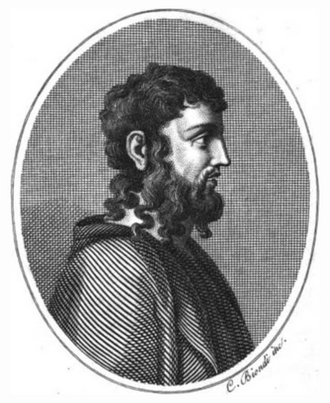
Dicaearchus
349 BC–284 BC · Greek Peripatetic philosopher and geographer from Messana
Dicaearchus of Messana (c. 350 BC - c. 285 BC) was a Greek philosopher of the Peripatetic school, as well as a geographer and historian. A pupil of Aristotle at the Lyceum in Athens, he belonged to a tradition that combined empirical inquiry with moral reflection. Today he is remembered chiefly for his geographical work, though his philosophy also carried weight in his own time.
Born in Messana in Sicily, he spent much of his life in Greece, especially in Athens and the Peloponnese. He was a friend of Aristoxenus and took part in political life. Only fragments of his output survive, but titles include Life of Greece, in three books, a survey of Greek cultural history from its beginnings, and Circuit of the Earth, a description of the known world. He also wrote a Spartan Constitution which, according to tradition, was read every year to the young men of Sparta.
His measurements of mountains in Greece, made with an instrument called a dioptra, were the earliest known attempt to calculate heights by triangulation in antiquity. He aimed to show that mountains did not noticeably affect the sphericity of the Earth, and several of his results were later adopted by Eratosthenes.
As a philosopher, he held that the soul is a harmony inseparable from the body, and that action takes precedence over contemplative life. His anthropological monism led him to deny the immortality of the soul; according to some commentators, including Cicero, he went so far as to deny that the soul existed at all. His naturalism led him to attribute priestly prophecies to physical causes rather than to the gods.
His work is known almost only through quotations by later writers, yet his Life of Greece inspired other historians, among them Jason and Varro. His reputation as a pioneer of cartography rests, according to modern scholarship, on a misreading of a passage in Cicero.
Key ideas
- Harmony of the soul: the soul is not a separate substance but the harmony that arises from the body.
- Primacy of action: practical and political life is worth more than theoretical contemplation.
- Mortality of the soul: his anthropological monism leads him to deny the soul's immortality.
- Natural explanation of divination: prophecies have physical causes, not divine ones.
Curiosities
A map that never existed
Modern historians have often called him a pioneer of cartography, but Cicero's reference to his « tabulae » is a pun on account books and does not describe maps.
A constitution read every year
According to the Suda, his Spartan Constitution was read each year to the young men of Sparta.
An accusation against Euripides
In his Life of Greece he claimed that Euripides' Medea plagiarised the play by the obscure tragedian Neophron.
Teachers and influences
Teachers
- Aristotle 383 BC–321 BC
Original Filopedia text based on Wikipedia (es) and Wikipedia (en) and Wikidata.