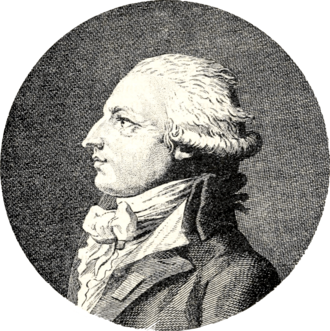
Antoine Destutt de Tracy
1754–1836 · French Enlightenment aristocrat, soldier and philosopher
Antoine Louis Claude Destutt, comte de Tracy (1754-1836), was a French aristocrat, soldier and philosopher of the Enlightenment. His name is tied to a word that still circulates: in 1801 he coined the term 'ideology', which for him meant the science of ideas. He belonged to the sensualist tradition inherited from Condillac and is regarded as the leading theorist of the group known as the idéologues.
He came from a family of Scottish origin and was educated at home and at the University of Strasbourg. A career soldier, he embraced the Revolution and served as a noble deputy in the Estates General, alongside La Fayette. Under the Terror he was imprisoned for nearly a year, and during that time he read Condillac and Locke and turned increasingly to philosophy. Earlier he had gathered at Auteuil with Cabanis and Condorcet, and in 1795 he was named a member of the Institut de France. Later, exiled in Brussels, he began publishing his Éléments d'idéologie, between 1801 and 1815.
In that work he aimed to found a basic discipline that would underpin all the sciences. He treated ideas as natural phenomena arising from the relation between a sensitive living being and its environment. For him, perception, memory, judgment and will were all forms of sensation. He defended the separation of powers, political liberty and freedom of the press, and favoured a republican government on the American model. His republicanism brought him into conflict with Napoleon, who turned the word 'ideology' into an insult and in 1812 banned the teaching of moral and political science.
His influence reached Stendhal, who attended his salon, and Auguste Comte, who drew on part of his positivist outlook. Thomas Jefferson also valued his work and prepared American editions of some of his manuscripts. His critique of Montesquieu and his support for representative democracy left a mark on nineteenth-century liberalism.
Key ideas
- Ideology: the science that studies the origin and development of ideas as natural phenomena.
- Sensation as foundation: perception, memory, judgment and will are all varieties of sensation.
- Political liberty: the separation of powers and freedom of the press are necessary conditions of individual freedom.
Curiosities
A word that changed meaning
He coined 'ideology' in a neutral sense, but Napoleon turned it into a term of abuse.
A salon with Stendhal
Stendhal attended his salon regularly in the 1820s, as he recalled in Memoirs of an Egotist.
Original Filopedia text based on Wikipedia (es) and Wikipedia (en) and Wikidata.