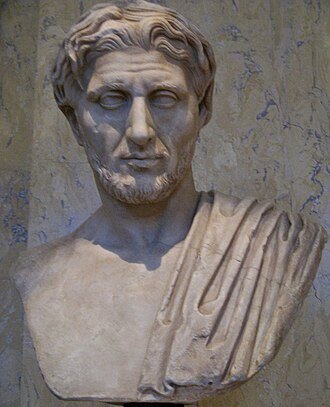
Demetrius of Phalerum
349 BC–282 BC · Athenian statesman, orator and Peripatetic philosopher
Demetrius of Phalerum (c. 350–c. 282 BC) was an Athenian statesman, orator and philosopher of the Peripatetic school. A student of Theophrastus and, perhaps, of Aristotle, he matters because he joined public life with serious thinking, and because his influence reached the way knowledge was gathered and organised at Alexandria.
Born in Phalerum, an old harbour of Athens, he was the son of Phanostratus, a man without rank or property. He was educated alongside the comic poet Menander and quickly earned a name as a public speaker. After the death of Phocion in 317 BC, Cassander placed him at the head of Athens, where he ruled for ten years. He carried out legal reforms and restricted funerary luxury through a sumptuary law, a measure still visible in the archaeology of Athenian cemeteries. His rule, however, was resented by the poorer citizens and by democrats, who saw him as a puppet of Macedon.
In 307 BC Demetrius Poliorcetes took Athens and he fled first to Thebes and later to Egypt, to the court of Ptolemy I, who received him well. There he turned mainly to literary work. He is credited, by tradition, with advising the translation of the Hebrew Bible into Greek, the Septuagint, and he is linked to the founding of the Library of Alexandria, though the extent of his role is debated. Having fallen from favour under Ptolemy II, he died in exile, according to a common account, from the bite of a snake.
Almost all of his writings on history, rhetoric, philosophy and poetry have been lost. Ancient sources remember him as a graceful, gentle orator, and his most lasting legacy is a method of library organisation that blended the Aristotelian ambition to gather all knowledge with formal practices from the Near East.
Key ideas
- The library as the memory of the world: the idea of gathering the whole of human knowledge in one place, inherited from Aristotle's Lyceum.
- A mixed library science: the combination of Aristotelian subject organisation with formal Eastern methods such as labelled tablets and colophons on each scroll box.
- Libraries as editorial laboratories: the task of deciding which authors deserved copying and study after philological revision.
- Graceful rhetoric: a soft, polished style, quite unlike the sublime manner of Demosthenes, marking a decline after the great age of Attic oratory.
- Law and public morals: legal reform and limits on funerary luxury as a way of moderating civic life.
Curiosities
A mistake by Hegel
Hegel claimed that Demetrius of Phalerum was worshipped as a god in Athens, but the confusion probably stems from a misreading of Plutarch's life of Demetrius Poliorcetes.
Disputed statues
It is said that the Athenians erected 360 statues in his honour, although historian Stephen V. Tracy argues that this story is not historical.
Original Filopedia text based on Wikipedia (es) and Wikipedia (en) and Wikidata.