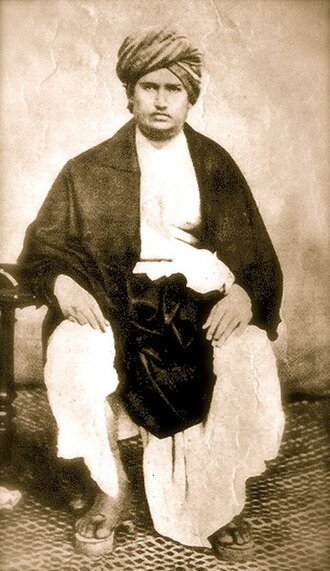
Dayananda Saraswati
1824–1883 · Indian religious reformer and founder of the Arya Samaj
Dayananda Sarasvati, born Mula Shankar Tiwari in Tankara, in the Kathiawar region of what is now Gujarat, was an Indian religious thinker, social leader and founder of the Arya Samaj, a reform movement within Hinduism that emerged under British rule. He matters because he tried to renew the Indian religious tradition from within, treating the Vedas as the main authority and denouncing practices he saw as corruptions.
He came from a Brahmin family and was raised in the worship of Shiva. According to a well-known account, at about the age of fourteen, during a night vigil, he watched mice eat the offerings and run over the god's image, and asked how Shiva could protect the world if he could not defend himself against a mouse. The deaths of a younger sister and an uncle from cholera turned him toward questions about life and death. To avoid an arranged marriage he left home in 1846 and joined the Sarasvati order of ascetics. Between 1845 and 1869 he wandered across India, visited the Himalayas and practised yoga. He became a disciple of Virajanand Dandeesha, who believed Hinduism had drifted from its roots, and promised to devote his life to restoring the Vedas to their rightful place.
From 1863 he preached a return to a purified Vedic religion. He held that the Vedas were the true source of dharma and contained knowledge compatible with modern science. He criticised idolatry, ritualism and the caste system, and argued that people of every caste should be able to study the sacred scriptures. He opposed child marriage and the ban on widow remarriage. He rejected the Puranas and Tantric texts as contrary to the Vedas, and his teaching included karma, reincarnation and three eternal realities: God, souls and nature. He debated orthodox Hindu scholars and Christian missionaries, and in 1875 founded the Arya Samaj. His major work, the Satyarth Prakash, remains an influential text on Vedic philosophy and human duties.
In 1876 he called for swaraj understood as India for Indians, a slogan later taken up by Lokmanya Tilak, although the modern political sense of the word does not appear in his writings. His influence was considerable: S. Radhakrishnan and Sri Aurobindo named him one of the makers of modern India, and those who claimed his legacy included Bhagat Singh, Lala Lajpat Rai and Vallabhbhai Patel.
Key ideas
- Authority of the Vedas: the Vedic texts are the sole, uncorrupted source of dharma, and other traditions should be judged by them.
- Rejection of idolatry: image worship and external rituals lead people away from true religion.
- Equal access to knowledge: people of every caste should be able to study the sacred scriptures.
- Karma and reincarnation: souls are reborn according to their deeds and can be liberated by knowing God, themselves and nature.
- India for Indians: his 1876 call for self-rule for India.
Works in Filopedia
Curiosities
The mice before Shiva
According to the account, seeing mice on the image of Shiva was the moment he began to doubt idolatry. He was about fourteen.
A steak that made him a vegetarian
It is said that after watching a Brahmin prepare a steak, he was so repelled that he never ate meat again.
Original Filopedia text based on Wikipedia (es) and Wikipedia (en) and Wikidata.