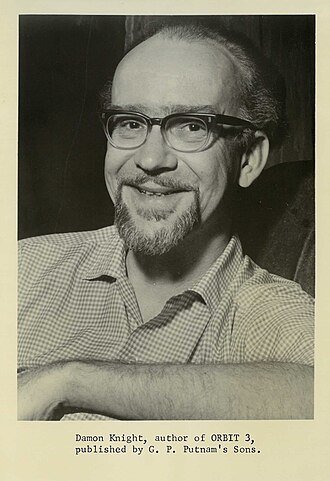
Damon Knight
1922–2002 · American science fiction writer, editor and critic
Damon Knight (Baker City, Oregon, 1922 - Eugene, Oregon, 2002) was an American science fiction writer, editor and critic. His significance lies in helping to treat the genre seriously as literature and in pushing its writers toward a more professional footing.
He grew up in Hood River, Oregon, and as a teenager became involved in fandom, the network of fans who produced fanzines. In the late 1930s he moved to New York, where he joined the Futurians, a group of young fans and writers that included Frederik Pohl and Donald A. Wollheim. His first stories appeared in publications connected to that circle. Over time he became known above all as a master of the short story.
He was also a sharp critic. From the mid-1940s he reviewed novels with a biting tone that earned him many enemies, but it also brought literary standards to a field often judged almost solely by its entertainment value. His reviews and essays were gathered in In Search of Wonder, a book often regarded as a founding text of modern science fiction criticism. As an anthologist he edited the Orbit series, which launched writers such as R. A. Lafferty and Gene Wolfe.
Concerned with the working conditions of writers, he founded the Science Fiction and Fantasy Writers of America (SFWA) in 1965 and served as its president until 1967. He also helped create writing workshops, including those at Milford and Clarion, where he taught for many years. His legacy lies in the writers trained in those classrooms, in his essays on narrative craft, and in his famous attempt to define science fiction as whatever we point to when we say the words science fiction.
Key works
- Hell's Pavement (1955): one of his novels of the 1950s, published during the middle of his career as a novelist.
- Masters of Evolution (1959): a 1959 novel from the decade when he was most active in fiction.
- The Futurians (1977): a memoir of his years in New York with the Futurian group, an essential source for the history of the genre.
- Creating Short Fiction (1981): a guide to writing short stories, drawn from his teaching at the Clarion workshop.
Works in Filopedia
- Hell's Pavement 1955
Curiosities
A story adapted for television
His 1950 short story «To Serve Man» was adapted for The Twilight Zone. In 2001 it received a Retro-Hugo as the best short story of that year.
A term from his reviews
His frequent use of the phrase «idiot plot», for stories that work only because nearly everyone in them is foolish, made it widely known. He himself believed James Blish had probably coined it.
Original Filopedia text based on Wikipedia (es) and Wikipedia (en) and Wikidata.