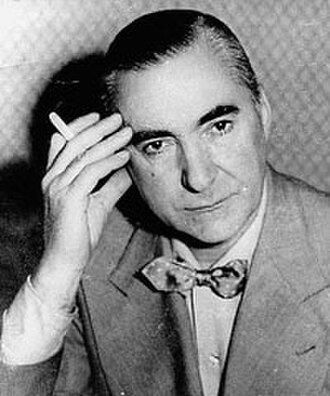
Curzio Malaparte
1898–1957 · Italian journalist, novelist and diplomat
Curzio Malaparte (Prato, 1898 - Rome, 1957), born Kurt Erich Suckert, was an Italian journalist, novelist, playwright, short-story writer and diplomat. He wrote in Italian, and his work is considered one of the most representative of Italy between the wars and the postwar years. He adopted his literary surname in 1925. Malaparte means roughly 'bad place' and plays on Buonaparte, the family name of Napoleon.
He was the son of a German father, a textile manufacturer, and an Italian mother. He grew up in Prato and attended the Cicognini school, which Gabriele D'Annunzio had also attended, and he later kept a complicated relationship with D'Annunzio's work, admiring and rejecting it at once. At the age of sixteen he wanted to join the First World War. He fought on the Col di Lana and in France, received a bronze medal, and suffered the effects of mustard gas. That experience shaped his first major book, Viva Caporetto!, which he published at his own expense in 1921 and which was seized because of its provocative title. In it he saw the defeat at Caporetto as the seed of a revolution and blamed the old ruling class for the incompetence of the war.
During the 1920s he moved close to Mussolini's fascism, which gave him platforms in the press. He founded magazines and, in 1926, co-founded with Massimo Bontempelli the literary quarterly '900'. His relationship with the regime, however, was unstable. In Coup d'Etat: The Technique of Revolution (1931) he treated the seizure of power as a technical problem and criticised Hitler, which cost him his membership of the National Fascist Party and led to internal exile on the island of Lipari from 1933 to 1938. During the Second World War he worked as a correspondent on the Eastern Front. His dispatches became Kaputt (1944), a semi-fictional account of the war, and later The Skin (1949), set in postwar Naples, which was placed on the Index of prohibited books.
After the war he moved toward the Italian Communist Party and settled in Paris, where he wrote plays with little success. He also directed the film Forbidden Christ (1950), which won a special prize at the Berlin International Film Festival. He died in Rome in 1957.
His legacy rests mainly on Kaputt and The Skin, which are still read as uncomfortable records of war and collective guilt. His style blends reportage and fiction, and his path from fascist enthusiasm to communism remains a subject of debate.
Key works
- Viva Caporetto! (1921): an essay-novel about the war that blamed the Italian ruling class for the defeat.
- Donna come me (1940): semi-fantastical autobiographical stories written after his imprisonment.
- Kaputt (1944): a semi-fictional account of the Eastern Front during the Second World War.
- The Skin (1949): a portrait of postwar Naples focused on morality and the humiliation of the defeated.
Curiosities
A surname with a double meaning
The name Malaparte plays on Bonaparte and means 'bad place', an ironic answer to Napoleon's family name.
A house on Capri
During his confinement on Capri he built the Casa Malaparte with the architect Adalberto Libera, which later served as a location in Jean-Luc Godard's film Le Mépris.
Original Filopedia text based on Wikipedia (es) and Wikipedia (en) and Wikidata.