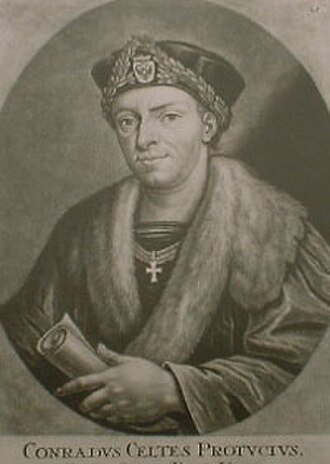
Conrad Celtes
1459–1508 · German humanist and Neo-Latin poet
Conrad Celtis (Wipfeld, 1459 - Vienna, 1508) was one of the leading humanists of the German Renaissance and a poet who wrote mainly in Latin. Born Konrad Bickel in Lower Franconia, he devoted his life to spreading the study of classical letters and to building a humanist culture in German lands, an unusual ambition at a time when Latin still dominated learned life.
He trained at Cologne and Heidelberg, where Johann von Dalberg and Rodolphus Agricola guided him. Like many humanists of his day, he latinized his name. He spent years travelling as an itinerant lecturer, through Erfurt, Rostock and Leipzig, and on to Rome, Florence, Bologna and Venice. His standing at the imperial court brought him the favour of Frederick III, who made him a poet laureate, and at Nuremberg he received that honour together with a doctorate.
In Kraków he studied mathematics, astronomy and the natural sciences, and in several cities he founded learned societies modelled on the Roman academies, among them the Sodalitas Litterarum Vistulana, the Danubiana and the Rhenana. His 1492 speech at Ingolstadt urged Germans to match the Italians in learning, and it later became a touchstone for German national feeling. Settled in Vienna under Maximilian I, he founded the Collegium poetarum et mathematicorum in 1501 and led it until his death from syphilis.
His output joined Latin verse, where he cultivated the ode and the elegy, with history, geography and cartography. He was among the first to propose a history of the world as a whole and undertook an ambitious project on Germania. He recovered the writings of Hrotsvitha of Gandersheim and gathered Greek and Latin manuscripts. His legacy lies in philology, in historical writing and in the way German humanism came to see itself.
Key works
- Ars versificandi et carminum (1486)
- Quattuor libri amorum (1502)
- De origine, situ, moribus et institutis Norimbergae libellus (1502)
- Epitoma in utramque Ciceronis rhetoricam (1492)
- Carmen saeculare (1500)
Curiosities
A latinized name
As was customary among humanists, he replaced his family name, Bickel, with the Latin form Celtis. His father wanted him to become a vintner, but he preferred to study.
A rediscovered author
According to the reference material, he is credited with rediscovering the writings of Hrotsvitha of Gandersheim in a Regensburg monastery, and he helped publish them widely.
Original Filopedia text based on Wikipedia (es) and Wikipedia (en) and Wikidata.