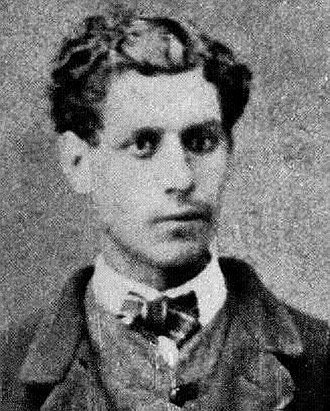
Comte de Lautréamont
1846–1870 · French-language poet from Uruguay, forerunner of Surrealism
Isidore Lucien Ducasse, who wrote under the name Comte de Lautréamont, was a French-language poet born in Montevideo in 1846 and who died in Paris in 1870, at the age of 24. He was almost unknown during his lifetime, but he is now seen as one of the forerunners of Surrealism. His output was small, yet its influence on modern poetry has been wide.
The son of a French consular official, he spent his earliest years in Montevideo during the Guerra Grande. At thirteen, his father sent him to school in France, first at Tarbes and then at Pau. There he read Poe, Byron, Shelley, Mickiewicz and Baudelaire, and resolved to become a writer. Toward the end of 1867 he settled in Paris, living on money sent by his father and without any known profession.
In Paris he worked on the first canto of Les Chants de Maldoror, which he published anonymously in 1868, marked only with three asterisks. He wanted the book to reach booksellers, but the Brussels publisher Albert Lacroix feared prosecution for blasphemy or obscenity and refused to distribute it. Around then he adopted the pseudonym Comte de Lautréamont, first used in an anthology published in Bordeaux in early 1869.
The work centres on Maldoror, a demonic figure who rejects both God and humanity. It mixes violent narrative with strange imagery, dark humour and sudden shifts of tone. Its division into cantos and stanzas recalls epic verse, though the sixth canto breaks away into a short novel. From Byron, Goethe and Mickiewicz he took the idea of a rebellious hero, but he shaped that figure in his own way.
In 1870 he published the Poésies under his own name, two brochures of aphoristic prose meant as the start of a work on goodness. In them he reworked and freely copied passages by Pascal, La Rochefoucauld and Dante. He fell ill during the siege of Paris and died in his hotel on 24 November 1870. He was buried in the Cimetière du Nord, and his remains were later lost.
His reputation rests mainly on the Surrealists, who rescued him from obscurity. André Breton, Aragon and Benjamin Péret cited him as an ancestor, and painters such as Dalí and Magritte drew on his imagery. His image of a sewing machine and an umbrella on a dissecting table became a emblem of unrelated realities brought together.
Key works
- Les Chants de Maldoror (1868-1869): a prose poem about a demonic hero who rebels against God, its first canto published in 1868 and the full work in 1869.
- Poésies (1870): two brochures of aphoristic prose, published under his real name, intended as a prelude to a work on goodness.
Works in Filopedia
Books to read
- Les Chants de Maldoror FrenchEPUB 268 KBRead online
Curiosities
A pseudonym with several readings
The name Comte de Lautréamont may derive from a character in a novel by Eugène Sue, though wordplays on Montevideo and his father's name have also been proposed.
An asteroid named after him
On 15 December 2025, the International Astronomical Union named the asteroid 434325 (2004 JD2) Lautréamont in his honour.
Remains lost
According to the biographical record, his remains were lost for good in the Pantin ossuary in 1890, after his burial in the Cimetière du Nord.
Teachers and influences
Influenced by
- Dante Alighieri 1265–1321
- Adam Mickiewicz 1798–1855
Influenced
- Julia Kristeva b. 1941
Original Filopedia text based on Wikipedia (es) and Wikipedia (en) and Wikidata.