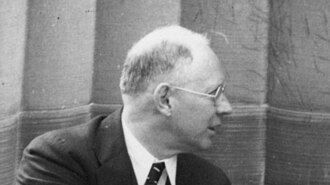
Clark L. Hull
1884–1952 · American psychologist and theorist of learning and motivation
Clark Leonard Hull (1884-1952) was an American psychologist who sought to explain learning and motivation through scientific laws of behavior. He belongs to the behaviorist tradition, and his work shaped experimental psychology in the middle decades of the twentieth century.
Born in Akron, New York, he studied at the University of Michigan, where he earned his bachelor's and master's degrees. He received his doctorate from the University of Wisconsin-Madison in 1918, and taught there from 1916 to 1929. His dissertation on the evolution of concepts was published in Psychological Monographs. In 1929 he moved to Yale University, where he remained until his death in New Haven in 1952.
Hull described behavior as a chain that begins with deprivation: deprivation creates needs, needs activate drives, and behavior is directed toward goals whose achievement has survival value. To express motivation, he proposed a formula linking reaction potential to habit strength, drive and the incentive value of a stimulus. His method was hypothetico-deductive: he started from observation, formed hypotheses and built precise axioms that he then tested experimentally. His books Mathematico-Deductive Theory of Rote Learning (1940) and Principles of Behavior (1943) made his theory the dominant learning theory of its day, and he debated Edward C. Tolman at length.
Hull also brought statistical and experimental rigour to hypnosis in Hypnosis and Suggestibility (1933). His findings helped separate hypnosis from sleep and curbed many exaggerated claims made by hypnotists. He received the Warren Medal in 1945.
His influence can be seen in students such as Neal E. Miller, John Dollard and Kenneth Spence, and in the idea of drive as the engine of learning. Although behaviorism later lost its prominence, his work is still cited in the history of psychology.
Key ideas
- Drive: a need created by deprivation that activates behavior and directs it toward a goal.
- Motivation formula: reaction potential depends on habit strength, drive and the incentive value of a stimulus.
- Hypothetico-deductive method: building theories from observations, hypotheses and precise axioms, then testing them experimentally.
- Biological adaptation: behavior as an interaction between the individual and the environment, aimed at reducing needs and improving living conditions.
Curiosities
A bout of polio that changed his path
While working as an apprentice mining engineer in Minnesota, he contracted polio, which left one leg paralysed. His recovery at his parents' home led him to rethink his life and eventually turned his interest towards psychology.
A memory shaped by illness
According to his biography, typhoid fever contracted in his youth left him with lasting amnesia and a poor memory for names, which affected him for the rest of his life.
Original Filopedia text based on Wikipedia (es) and Wikipedia (en) and Wikidata.