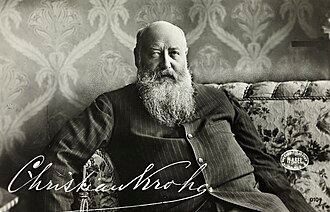
Christian Krohg
1852–1925 · Norwegian naturalist painter, writer and journalist
Christian Krohg (born 1852 in Vestre Aker, now part of Oslo; died 1925 in Kristiania) was a Norwegian painter, novelist and journalist who helped carry Norwegian art from romanticism towards naturalism. He directed the Norwegian Academy of Arts and taught there as its first professor from 1909 until his death in 1925.
He came from a family of lawyers and civil servants: his grandfather had been a government minister, and his father, Georg Anton Krohg, worked as a civil servant, journalist and writer. His mother died when he was eight, and his aunt took over the household. His father wanted him to study law, and he did, though painting was what he really wanted. After his father's death in 1873 he left for Germany, studying in Karlsruhe and Berlin, where Georg Brandes and others pushed him towards naturalism.
From 1879 he returned repeatedly to the artists' colony at Skagen, whose community shaped painters such as Anna and Michael Ancher. He also spent time in Paris, where he met the Impressionists without fully adopting their methods. His work turned to everyday life, often its harder sides: workers, women and urban poverty. His paintings of prostitutes are the best known. His novel Albertine (1886) told the story of a prostitute, caused a scandal and was confiscated by the police. For its social concerns he was called 'the artist of social conscience'.
Krohg was also a journalist, writing for Verdens Gang from 1890 to 1910, and he founded the bohemian journal Impressionisten. His marriage to the painter Oda Krohg and the career of their son, the painter Per Krohg, tie him to a notable artistic family. His legacy lies in bringing a realist eye to Nordic painting and in training a generation of artists through the academy.
Key works
- Albertine at the Police Doctor's Waiting Room (1885-1887): a scene of prostitution that marked Norwegian social realism.
- Albertine (1886): a novel about a prostitute, banned and confiscated on publication.
- The Struggle for Existence (c. 1888-1889): a painting of poverty and working-class survival.
- Sleeping Mother with Child (1883): an intimate scene of domestic life.
Original Filopedia text based on Wikipedia (es) and Wikipedia (en) and Wikidata.