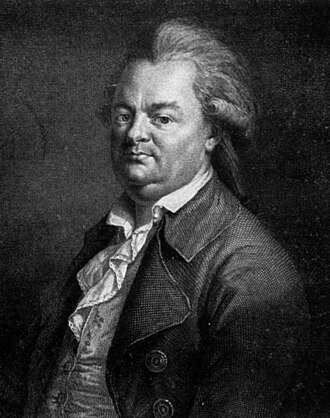
Christian Friedrich Daniel Schubart
1739–1791 · German poet, musician and journalist
Christian Friedrich Daniel Schubart (1739-1791) was a German poet, organist, composer and journalist, associated with the Sturm und Drang movement in the Duchy of Württemberg. He wrote in German. His name today rests on his poems, his politically sharp journalism, and the songs other composers later set to his verse.
Born at Obersontheim in Swabia, he entered the University of Erlangen in 1758 to study theology, but a dissolute life and a strong musical gift pulled him away from the pulpit. He tried tutoring and work as an assistant preacher before becoming organist at Geislingen an der Steige. In Ludwigsburg in 1772 the English traveller Charles Burney praised him as the finest harpsichordist he had met in Germany, though local opinion often regarded him as eccentric.
A blasphemous parody of the litany cost him his position in Württemberg and forced him to move from town to town. In Augsburg he began the journal Teutsche Chronik in 1774, using it to attack the duchy's absolutism and to take aim at the Jesuits. After a bitter attack on the order he was expelled from Augsburg, and in 1777 he was arrested at Ulm and confined in the fortress of Hohenasperg. He spent roughly a decade in harsh conditions, reading mystical writings and composing poetry. His collected poems appeared in Stuttgart in 1785 and 1786, and most of them bear the marks of Sturm und Drang.
Frederick the Great freed him in 1787. Schubart was then made musical director and manager of the theatre in Stuttgart, and he began an autobiography that remained unfinished when he died in 1791.
His legacy is twofold. His poetry and journalism reflect the political climate of late eighteenth-century Germany. His essay on musical aesthetics, published in 1806, interests historians of music thought. His best-known afterlife came through Schubert, who set his poem The Trout in 1817. He is also traditionally said to have supplied material for Schiller's The Robbers, though that claim rests more on tradition than on firm evidence.
Key works
- Teutsche Chronik (1774-1778), a journal from Augsburg in which he attacked absolutism and the Jesuits.
- Poems (1785-1786), a collection written largely during his imprisonment.
- Die Forelle (The Trout) (1783), a poem about a fish caught by a fisherman, set to music by Schubert in 1817.
- On the History of the Human Heart (1795), an essay on human passions and conduct.
- Ideas on the Aesthetics of Music (1806), an essay on the art and purpose of music.
Books to read
- Ideen zu einer Ästhetik der Tonkunst GermanEPUB 410 KBRead online
Curiosities
Burney's praise
In 1772 the English traveller Charles Burney called him the finest harpsichordist he had met in Germany, even though many in Ludwigsburg thought him eccentric.
Mozart versus Beecke
In 1775 he wrote in his Teutsche Chronik that Captain von Beecke far surpassed Mozart as a keyboard player, a verdict that reflects his personal taste.
Original Filopedia text based on Wikipedia (es) and Wikipedia (en) and Wikidata.