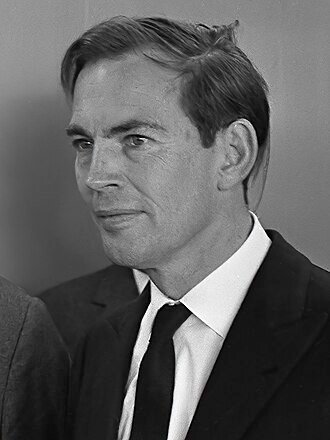
Christiaan Neethling Barnard (born in Beaufort West, Cape Province, in 1922; died in Paphos, Cyprus, in 2001) was a South African cardiac surgeon who carried out the first human-to-human heart transplant on record, on 3 December 1967. His name has since become tied to the history of cardiac surgery and to the debates about its limits.
Barnard grew up in Beaufort West, where his father was a minister in the Dutch Reformed Church. The family suffered the early death of one of his brothers from a heart problem, a loss that later shaped his interest in the heart. He studied medicine at the University of Cape Town, qualifying in 1945, and worked as a country doctor in Ceres before returning to the city to train at Groote Schuur Hospital.
His first serious research concerned intestinal atresia, a congenital blockage of the intestines that threatens newborn babies. After forty-three attempts on dogs, he reproduced the condition in a puppy still in the womb, then cured it by removing the section of bowel with poor blood supply. The method saved ten babies in Cape Town and was taken up by surgeons in Britain and the United States. Between 1955 and 1958 he worked in Minneapolis, where he came into contact with Walt Lillehei's open-heart surgery team, and on his return he headed the Department of Experimental Surgery at Groote Schuur. Over time he earned a reputation for his work on heart conditions such as tetralogy of Fallot and Ebstein's anomaly.
The 1967 operation made him world famous. The donor was Denise Darvall, a young woman killed after being struck by a vehicle, and the recipient was Louis Washkansky, a middle-aged merchant with severe heart disease and diabetes. Washkansky woke and could speak with his wife, but he died eighteen days later of pneumonia, largely caused by the anti-rejection drugs that weakened his immune system. Barnard had told the family the operation had an 80% chance of success, a figure later criticised as misleading. His second patient, Philip Blaiberg, lived for another year and a half.
His legacy is twofold: a surgeon who opened the way to modern heart transplantation, and a public figure whose choices were widely debated. He retired in 1983 after rheumatoid arthritis ended his operating career, turned to anti-ageing research and founded a charity for disadvantaged children. In 1986 his reputation suffered when he endorsed an expensive skin cream, whose approval in the United States was soon withdrawn. He died in 2001, aged 78, after an asthma attack.
Key works
- One Life (1969)
- The Unwanted (1974)
- Good Life, Good Death (1980)
- The Second Life (1993)
- Fifty Ways to a Healthy Heart (2000)
Curiosities
An optimistic forecast
Barnard told Washkansky's family the operation had an 80% chance of success. That estimate was later criticised as misleading.
A brother with a heart condition
One of his brothers, Abraham, was a blue baby who died of a heart problem at the age of three. Barnard later guessed it had been tetralogy of Fallot.
Original Filopedia text based on Wikipedia (es) and Wikipedia (en) and Wikidata.