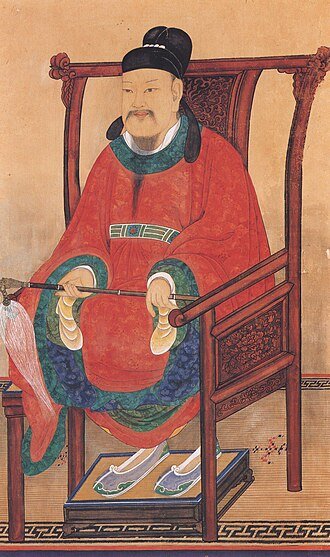
Choe Chiwon
857–901 · Korean philosopher and poet of the Unified Silla period
Choe Chiwon (857–c. 924) was a Korean philosopher and poet of the Unified Silla period (668–935). Trained in Confucian learning and of mixed social origin, he is today recognized as the progenitor of the Gyeongju Choe clan, and his life links the literary tradition of Tang China with Korean Buddhism.
Born in Gyeongju, the Silla capital, he belonged to the so-called "head rank six" class, which was barred from the highest offices by Silla's strict hereditary rank system. At twelve, in 869, his father sent him to study in Tang China, with the warning that he would be disowned if he failed the imperial examination within ten years. He passed it and spent nearly a decade in Chinese service, even becoming acquainted with Emperor Xizong. He returned to Silla in 885 and, after a series of teaching and administrative posts, submitted his "Ten Urgent Points of Reform" to Queen Jinseong in 894. The court ignored them, as the state was already collapsing.
Around 900 he withdrew from public life and lived as a scholar-hermit, mainly near the Haeinsa temple, where his elder brother was abbot. There he wrote stele inscriptions honoring Buddhist monks, which are now a key source on Silla Buddhism. After his death his reputation grew: in Confucian Korea he received a posthumous title and his portrait was venerated in the national shrine, while his poems, written in Chinese, survive in good number.
Key ideas
- Practical Confucianism: good government depends on officials formed in classical ethics and letters, and learning should serve the state.
- State reform: Silla's decline demanded restoring central authority against the aristocracy and regional warlords.
- Buddhist retreat: in old age, contemplative life and Buddhism offered an alternative meaning to a public career.
- Loyalty to Silla: the tension between duty to the state and the reality of its collapse shaped both his thought and his poetry.
Curiosities
A stern father
According to the Samguk sagi, his father warned him that if he did not pass the Chinese imperial examination within ten years, he would no longer be his son.
A name tied to Busan
Haeundae district in modern Busan takes its name from his pen-name Haeun, as he is said to have loved the site so much that he built a pavilion there.
Original Filopedia text based on Wikipedia (en) and Wikidata.