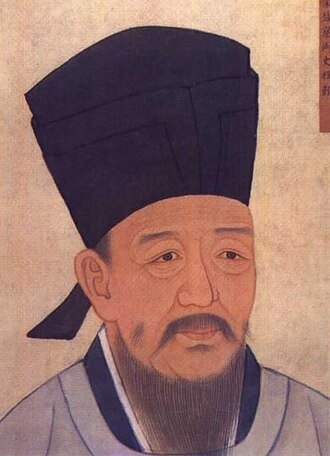
Cheng Hao
1032–1085 · Chinese Neo-Confucian philosopher and politician of the Song dynasty
Cheng Hao (1032-1085) was a Chinese philosopher and politician born in Luoyang, during the Song dynasty. Together with his younger brother Cheng Yi, he was one of the pioneers of Neo-Confucianism, a movement that reshaped Confucian thought by drawing on cosmology and metaphysics. Both brothers studied under Zhou Dunyi, one of the architects of that cosmology, and they are regarded as founding figures of what later became known as the Cheng-Zhu school.
His public career began after he passed the imperial examinations in 1057. He held a series of administrative posts in several localities, including Hu, Shangyuan and Zezhou, and later served in ceremonial administration, censorship and taxation. At the same time he founded schools at Fugou and Songyang, where he argued that study and scholarship were the path to becoming a sage.
His thought blends a dualism between the tangible and the intangible with a pantheistic outlook: the intangible, whether God, human nature, movement or chance, points to one unified principle present in everything that can be perceived, rather than to an external reality as in Platonism. The brothers applied the concept of li, natural order, to Tian, Heaven, as its original and guiding power. Cheng Hao was known for a warm, lively temperament, in contrast to his stern brother. Over time, he and his brother, together with Zhou Dunyi, Zhang Zai, Shao Yong and Sima Guang, came to be known as the Six Masters of the Northern Song, and their influence on later Neo-Confucianism was wide.
Key ideas
- Dualism and pantheism: distinguishes between the tangible and the intangible, yet holds that the intangible is unified in a single principle present in all perceptible things.
- Li as ordering principle: natural order (li) is identified with Heaven (Tian) as the original and guiding power.
- Study as the path to wisdom: learning and scholarship are the means by which people can attain sagehood.
- Unity of the intangible: God, human nature, feelings and movement are understood as expressions of one and the same principle.
Curiosities
A temperament unlike his brother's
Cheng Hao was remembered as an outgoing, relaxed and lively man, in contrast to the stern character of Cheng Yi.
The Six Masters of the Northern Song
He and his brother were grouped, along with Zhou Dunyi, Zhang Zai, Shao Yong and Sima Guang, under the name Six Masters of the Northern Song.
Original Filopedia text based on Wikipedia (es) and Wikipedia (en) and Wikidata.