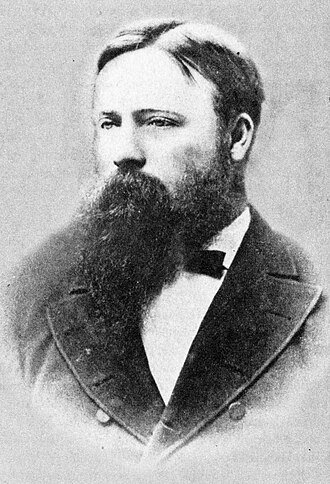
Chauncey Wright
1830–1875 · American philosopher and mathematician, early defender of Darwinism
Chauncey Wright (Northampton, Massachusetts, 1830 – Cambridge, 1875) was an American philosopher and mathematician who defended Darwin early on and exerted a notable influence on American pragmatists such as Charles Sanders Peirce and William James. The son of a merchant, he studied at Harvard, where reading Ralph Waldo Emerson pushed him away from the Unitarianism of his youth.
He graduated in 1852 and worked as a computer for the Nautical Almanac. During the 1850s he turned toward philosophy, reading Bacon, Mill and Hamilton, and wrote frequently for the North American Review and The Nation. He became publicly known as a defender of Darwin and a critic of Herbert Spencer, whom he faulted for turning evolution into a law of cosmic and social progress. His thinking was eclectic and positivist: science should avoid metaphysical commitments, and its principles are working hypotheses. In 1872 he helped found the Metaphysical Club in Cambridge. He died of a stroke shortly after his forty-fifth birthday.
His influence reached John Dewey and later pragmatists, and his claim that science is metaphysically neutral is often regarded as his central contribution.
Key ideas
- Darwinism: natural selection explains the origin of species and deserves a defence against its critics.
- Scientific principles as working hypotheses: laws are provisional tools rather than metaphysical truths.
- Metaphysical neutrality of science: science need not commit itself to naturalism, idealism or any other worldview.
- Agnosticism: lacking firm evidence either way, the sensible course is to suspend judgment on God's existence.
- Qualified utilitarianism: following Mill, pleasures differ in quality as well as quantity.
Original Filopedia text based on Wikipedia (en) and Wikidata.