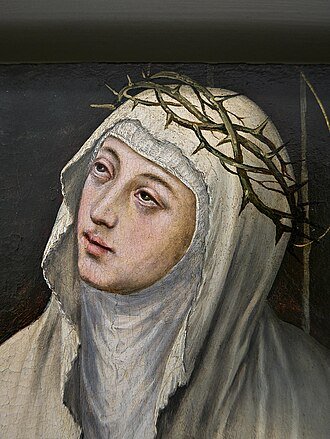
Catherine of Siena
1347–1380 · Dominican tertiary and mystic from Italy, co-patron of Europe and Doctor of the Church
Catherine of Siena (Siena, 1347 – Rome, 1380) was an Italian Dominican tertiary and mystic, venerated as a saint by the Catholic Church and recognised as a Doctor of the Church. She lived in the fourteenth century, during a period of deep crisis for the papacy, and her importance rests on both her writings and her involvement in the politics of the Holy See and the Italian republics, carried out largely through an extensive correspondence. She is one of the leading figures of medieval mysticism, and her works also hold a place in the history of Italian literature.
The daughter of Jacopo Benincasa, a cloth dyer, and Lapa Piagenti, she grew up in a large family in Siena. As a child she was so cheerful that her brothers nicknamed her Euphrosyne, the Greek word for joy. According to her confessor and biographer Raymond of Capua, she had her first vision of Christ at around the age of five or six. When her family arranged a marriage for her, she cut off her hair and refused, dedicating herself to prayer and penance and to severe fasting. She later joined the Mantellate, a loosely organised group of devout women following Dominican spirituality, and spent much of her time caring for the sick and prisoners. Some historians, such as Rudolph Bell, have read her fasting as a case of anorexia nervosa, although that interpretation remains debated.
Around 1370 she began writing letters to people of every social rank and became involved in public affairs. She called for peace among the Italian republics and for the return of the pope from Avignon to Rome. Her influence on Gregory XI helped persuade him to return to Rome in 1377. She was later sent as a negotiator to Florence, and a peace was reached in July 1378. Back in Siena she dictated her major spiritual work, The Dialogue of Divine Providence, to her secretaries.
During the Great Schism of the West she supported Pope Urban VI, writing to princes and cardinals to defend obedience to the pontiff and what she called the vessel of the Church. She died in Rome in April 1380, worn out by her fasting, and was buried in the basilica of Santa Maria sopra Minerva. Her central ideas turn on the inner life: the conviction that the soul can build within itself a place of recollection that no outward circumstance can take away, and union with Christ as the foundation of a total gift of self to others, expressed in her account of a mystical marriage.
Her reputation grew quickly. Pius II canonised her in 1461, and she was later named patron saint of Rome (1866), of Italy alongside Francis of Assisi (1939), and co-patron of Europe (1999). In 1970 Paul VI declared her a Doctor of the Church, the second woman to receive that title, shortly after Teresa of Ávila. Her confessor Raymond of Capua and her secretary Stefano Maconi helped preserve her memory, and she remains an important reference in the history of Christian spirituality and of the Church.
Key ideas
- Inner life: recollection in prayer as a refuge that no outward circumstance can take away.
- Union with Christ: the experience of a mystical marriage as the basis of a total surrender to God.
- Practical charity: service to the sick and the poor as a concrete expression of Christian love.
- Obedience to the pope: defence of the unity of the Church and papal authority during the Great Schism.
- Divine providence: her treatise The Dialogue of Divine Providence, in which she reflects on God's action in the world.
Books to read
- Libro della divina dottrina: Dialogo della divina provvidenza ItalianEPUB 446 KBRead online
Curiosities
Euphrosyne
Her brothers called her Euphrosyne, Greek for joy, because she was so cheerful as a child.
A dove at prayer
According to her biographer, a dove landed on her head while she was praying, which convinced her father that her vocation was sincere.
Invisible stigmata
On 1 April 1375, in Pisa, she received the so-called invisible stigmata: she felt the pain of the wounds, but they were not visible from outside.
Original Filopedia text based on Wikipedia (es) and Wikipedia (en) and Wikidata.