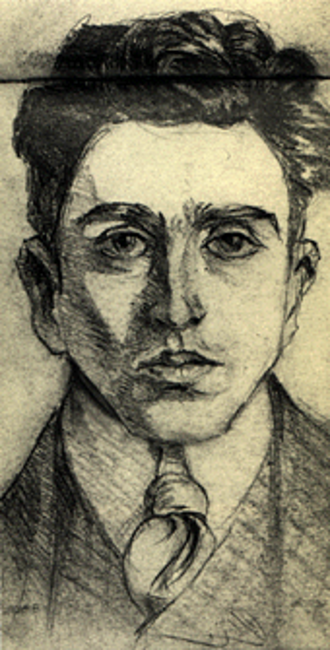
Carlo Michelstaedter
1887–1910 · Italian-speaking philosopher, poet and draughtsman from Austria-Hungary
Carlo Michelstaedter (Gorizia, 1887 - Gorizia, 1910) was an Italian-speaking thinker born in a city that today lies on the Italian-Slovenian border and then belonged to Austria-Hungary. Although he is remembered mainly for his philosophy, he also drew, painted and wrote poetry. His main work, Persuasion and Rhetoric, grew out of his university thesis and remains one of the most distinctive texts of early twentieth-century Italian philosophy.
Born into an upper middle-class Jewish family, he studied in Florence, where he focused on Greek and Latin. His thesis examined persuasion and rhetoric in ancient philosophy, and drew on Hegel, Marx and Schopenhauer to describe an organised society that keeps the individual in a state of dependence. After returning to Gorizia in 1909, he finished the work in late 1910. On 17 October of that year he took his own life with a gunshot, at a moment of exhaustion and family conflict. The reasons for his suicide are still debated.
For Michelstaedter, ordinary life is a kind of absence of life, shaped by the pursuit of pleasure and the search for security. Persuasion means self-possession, reached by living in the present as if each moment were the last. His ideas were later recognised by Heidegger, Wittgenstein and Derrida, who saw him as a forerunner in their own fields.
Key ideas
- Rhetoric: organised social life, in which people master nature and themselves in pursuit of pleasure and security.
- Persuasion: self-possession, reached by living the present without fear of death.
- Correlativity: a system of opposing wills in which each person sees others as objects useful to their own needs.
- The tragic: a way of finding meaning in existence in the face of nihilism, developed by Michelstaedter in 1907-1908.
Curiosities
A tragic end
According to the sources, he shot himself after an argument with his mother, who complained that he had not wished her a happy birthday.
A family scattered by war
As his family was Jewish, they were deported to Auschwitz; only one sister escaped to Switzerland.
Teachers and influences
Influenced
- Julius Evola 1898–1974
Original Filopedia text based on Wikipedia (es) and Wikipedia (en) and Wikidata.