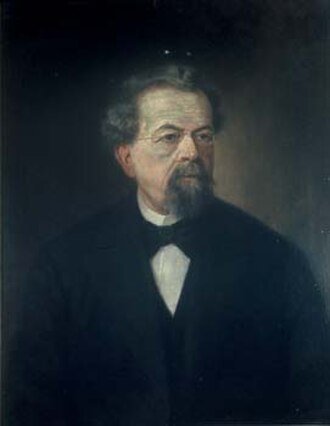
Karl von Prantl
1820–1888 · German philosopher and philologist, commentator on Aristotle and historian of logic
Carl von Prantl (Karl von Prantl, 1820-1888) was a German philosopher and philologist who worked in the Hegelian tradition and became known above all as a scholar of Aristotle and a historian of logic. Born in Landsberg on the Lech, in the Kingdom of Bavaria, he earned his doctorate in philosophy in 1843 and was appointed professor at the Munich observatory in 1859. He was a member of the academies in Berlin and Munich, and after 1872 he was known as Ritter von Prantl.
His philosophical position followed Hegel. In Die gegenwärtige Aufgabe der Philosophie (1852) and Verstehen und Beurteilen (1877) he defended and extended that legacy, stressing that for consciousness the subjective and the objective form a unity, and that perceiving this unity is peculiar to human beings.
His lasting contribution, however, lies in philology. He studied Aristotle in works such as Aristoteles über die Farben (1849) and Aristoteles acht Bücher der Physik (1857), along with many articles on specific questions, such as the authenticity of the thirty-eight books of the Problems. His best-known work is the four-volume Geschichte der Logik im Abendlande (1855-1870), a history of logic in the West. Christoph von Sigwart acknowledged in the preface to the first edition of his Logic the help he had received from it. Prantl died in Oberstdorf in 1888.
Key ideas
- Identity of the subjective and the objective: for consciousness, both aspects form a unity, and grasping that unity is a distinctively human capacity.
- Hegelian continuity: he defended and developed Hegel's tradition against other currents of his time.
- Aristotelian scholarship: he studied Aristotle's works rigorously, from questions of physics and colour to the authenticity of texts attributed to him.
- History of logic: his major work traces the development of logic in the West and served as a reference for later authors.
Teachers and influences
Teachers
- Friedrich Adolf Trendelenburg 1802–1872
Original Filopedia text based on Wikipedia (en) and Wikidata.