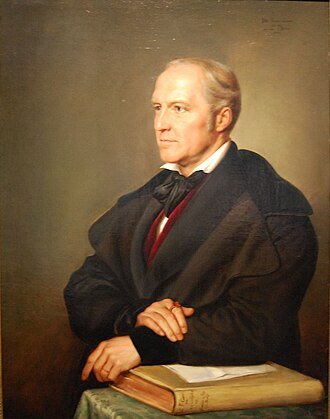
Carl Gustav Carus
1789–1869 · German physician, naturalist and Romantic painter, a leading figure of Naturphilosophie
Carl Gustav Carus (Leipzig, 1789 – Dresden, 1869) was a German physician, naturalist, painter and psychologist, and one of the most prominent figures of Naturphilosophie, the Romantic current that sought to understand nature as a living, unified whole. His work spans the first half of the nineteenth century and links Romanticism with biology and psychology, so it deserves attention beyond the anatomy textbooks.
He trained in medicine and philosophy, earned his doctorates in 1811, and in 1814 was appointed professor of obstetrics and director of the maternity clinic in Dresden. At the same time he taught himself oil painting while working under Caspar David Friedrich from 1814 to 1817, and later studied with Julius Schnorr von Carolsfeld. Much of his life unfolded in Dresden, where he died in 1869. In 1844 he accompanied King Frederick Augustus II of Saxony on a tour of Britain as his personal physician, and he later published an account of that journey.
His best-known scientific contribution is the idea of the vertebrate archetype: the notion that the solid parts of animals are variations of a single basic unit, the vertebra, which itself was thought to derive from a spherical form. This speculation, criticised by Étienne Geoffroy Saint-Hilaire, belonged to the intellectual climate that led toward the theory of evolution. In his later years he also argued that the shape of the skull could reveal character, in the tradition of craniology.
In psychology, his book Psyche (1846) held that the soul develops across natural history and across the individual life. He is credited with pointing to the unconscious as the essential basis of the psyche, an idea that Carl Jung acknowledged as a precursor. As a painter he developed a theory of landscape whose aim was to make visible the inner workings of geological phenomena, which he called the pictorial art of the life of the earth.
His influence on German science and art in the nineteenth century was considerable, and his name remains linked to scientific Romanticism.
Key ideas
- Vertebrate archetype: the solid parts of all animal bodies would be variations of one basic unit, the vertebra.
- Unity of nature: Naturphilosophie viewed the natural world as a living whole governed by shared principles.
- The unconscious: the soul has a dark, non-conscious foundation that psychology must study.
- Landscape as a visualisation of the earth: painting should show the inner processes of geological phenomena.
Curiosities
A family link
His daughter Charlotte married the sculptor Ernst Rietschel.
A royal journey
In 1844 he travelled to Britain with the King of Saxony, and both were guests of Queen Victoria and Prince Albert at Windsor Castle.
A Swedish academician
In 1836 he was elected a foreign member of the Royal Swedish Academy of Sciences.
Original Filopedia text based on Wikipedia (es) and Wikipedia (en) and Wikidata.