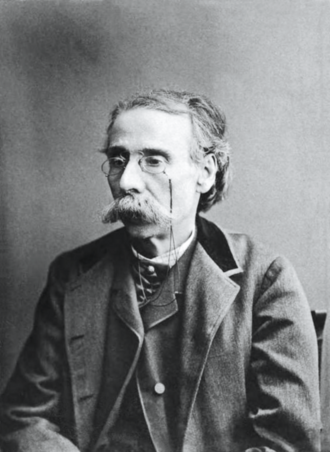
Camilo Castelo Branco
1825–1890 · Portuguese Romantic novelist
Camilo Castelo Branco (born in Mártires, 1825; died in Vila Nova de Famalicão, 1890) was a Portuguese Romantic novelist and one of the most widely read writers of nineteenth-century Portugal. His name is tied to the passionate novel and to a life as turbulent as the stories he wrote, a quality that found its way into much of his work.
Born outside marriage and orphaned at an early age, he was raised by relatives in the north of the country. His schooling was patchy. He admired Camões and Bocage, showed real talent for Greek and Latin, and never finished his medical studies or settled into discipline. His private life was marked by an early marriage, stormy love affairs and public scandal, including his relationship with Ana Plácido, which led to an adultery trial and a long imprisonment in Oporto, where he is said to have written Doomed Love.
From 1848 he earned his living through journalism and serialised fiction. His first serious novel, Os Mistérios de Lisboa, shows the influence of Balzac and Eugène Sue. His output is often divided into three phases: imaginative romances, novels of manners that portray middle-class and provincial life in the north, and, late in his career, historical, biographical and critical works. He is best remembered for tragic novels of forbidden love, though he also wrote satire, as in The Fall of an Angel, along with plays, poems and essays. His style is known for an enormous vocabulary and a biting, dry humour, and in the Novelas do Minho he offered realistic portraits of rural life.
His literary rivalry with the younger Eça de Queiroz, a champion of Realism, is now seen as a key to nineteenth-century Portuguese literature. Late in life, failing eyesight and a chronic nervous illness led him to take his own life in 1890. His legacy lies in Portugal's tradition of passionate fiction and in his distinctive blend of Romanticism, irony and satire.
Key works
- Doomed Love (Amor de Perdição, 1862): a forbidden romance between two young people from feuding families, often considered his most representative Romantic novel.
- Love of Salvation (Amor de Salvação, 1864): a later companion to Doomed Love, written in a more indirect tone with some humour.
- Novelas do Minho (1875-1877): a collection of twelve tales offering a realistic picture of rural life in northern Portugal.
- The Fall of an Angel (A Queda dum Anjo, 1866): a political satire about a countryman who falls into the corrupt world of Lisbon politics.
Works in Filopedia
- The Fall of an Angel 1866
Books to read
- Amor de Salvação PortugueseEPUB 204 KBRead online
- Scenas Contemporaneas PortugueseEPUB 216 KBRead online
Curiosities
A long spell in prison
He spent a long period locked up in the old Relação prison in Oporto after being tried for adultery. According to tradition, he wrote one of his most celebrated works, *Doomed Love*, while imprisoned there.
An end tied to a chair
He took his own life in 1890 at his home in San Miguel de Ceide, while sitting in a wooden rocking chair that has since become a well-known object in his story.
Original Filopedia text based on Wikipedia (es) and Wikipedia (en) and Wikidata.