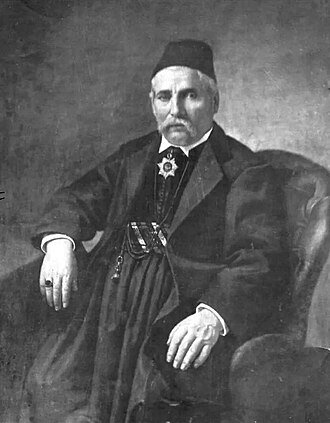
Butrus al-Bustani
1819–1883 · Lebanese writer and scholar
Butrus al-Bustani (1819–1883) was a Lebanese writer and scholar from a Maronite Christian family who worked in Mount Lebanon and Beirut, then part of the Ottoman Empire. He is a central figure of the Nahda, the Arab cultural revival of the nineteenth century, and is considered the first Syrian nationalist. His significance lies in promoting a modern Arab culture built on secular education and on Arabic as a language of learning.
He was born in the village of Dibbiye, in the Chouf region, and at eleven was sent to the school at ʿAyn Warqa, where he studied Syriac, Latin and several European languages. In 1840 he worked as an interpreter for British forces in Syria and soon joined the American Protestant mission in Beirut as a teacher. While helping with the Arabic Bible translation, he learned Hebrew, Aramaic and Greek, and he converted to Protestantism.
Around 1859 he stepped away from the mission and began arguing for an Arab culture expressed in its own language. After the 1860 civil war in Mount Lebanon he published Nafīr Sūriyya, an irregular newspaper in which he set out his ideal of a Syrian homeland. In 1863 he founded the madrasa al-wataniyya in Beirut, a secular school that admitted pupils of every religion; it was closed in 1878 amid rising religious solidarity. In 1870 he founded the periodical Al-Jinan.
His encyclopedic and lexicographical work was decisive. Muḥīṭ al-Muḥīṭ, usually regarded as the first Arabic encyclopedia, and Dāʾirat al-Maʿārif, a large reference work, aimed to gather a shared, universal body of knowledge, though his model owed much to Europe. He argued for separating church and state in the French manner, but did not seek religious reform, and he sought to recover the scientific past of the Arabs.
His legacy is the idea of a public, equal education and the establishment of Arabic as a language of the press, science and politics. He is remembered as the “Master and Father of the Arabic Renaissance.”
Key works
- Nafīr Sūriyya (1860s), an irregular newspaper in which he set out his ideal of a Syrian homeland.
- Muḥīṭ al-Muḥīṭ (1860s), regarded as the first Arabic encyclopedia, conceived as a dictionary of knowledge.
- Dāʾirat al-Maʿārif (1860s), a major reference work that aimed to gather modern knowledge in Arabic.
Curiosities
Nine languages
While working on the Bible translation, he learned Hebrew, Aramaic and Greek, bringing the number of languages he mastered to nine.
A school without creed
His Beirut school admitted pupils of any religion and hired teachers for their competence rather than their faith. It was closed in 1878.
A mother of the Nahda
His wife, Rahil Ata (1826–1894), is called the mother of the Nahda movement.
Original Filopedia text based on Wikipedia (es) and Wikipedia (en) and Wikidata.