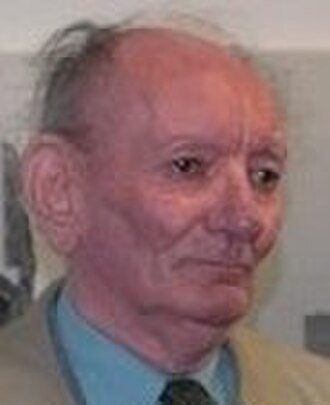
Brian Friel
1929–2015 · Irish dramatist and short story writer
Brian Friel (Omagh, Northern Ireland, 1929 – Greencastle, Republic of Ireland, 2015) was an Irish dramatist and short story writer who wrote in English and is widely regarded as one of the finest playwrights of his generation. Critics have compared his work with that of Samuel Beckett, Arthur Miller, Harold Pinter and Tennessee Williams, and he is often called the "Irish Chekhov".
Born in the countryside of Fermanagh, he grew up largely in Omagh and then Derry, where the family settled when he was about ten. He trained as a teacher and taught mathematics for a decade before leaving the classroom in 1960 to write full time, living on his savings. He had already been broadcast on radio in the late 1950s, and from 1959 he published short stories in The New Yorker, gathered in two well-received collections.
His breakthrough came with Philadelphia, Here I Come! (1964), which made him known in Dublin, London and New York. Much of his drama is set in Ballybeg, an invented small town that lets him trace the change in rural Irish life from the isolation of the 1960s to the affluent, multicultural 1990s. After a period of political satire aimed at the Irish government, he turned to the history and identity of the nation without losing his interest in private lives and silences.
In 1980 he co-founded the Field Day Theatre Company with Stephen Rea; its first production was Translations. Through Field Day he worked with the poet Seamus Heaney, who won the Nobel Prize in Literature in 1995. Dancing at Lughnasa revived his reputation in the 1990s, earning Tony and Laurence Olivier awards and a film starring Meryl Streep. He was a member of several literary academies and sat in the Irish Senate from 1987 to 1989. His legacy lies in Irish theatre and in his readiness to examine collective memory with irony and compassion.
Key works
- Philadelphia, Here I Come! (1964): a young man on the eve of emigrating, split between his public and private selves.
- Translations (1980): English surveyors arrive in a nineteenth-century Irish-speaking village, and a language is lost.
- Dancing at Lughnasa (1990): five sisters in a 1930s village, seen through the eyes of an adult narrator.
- Faith Healer (1979): four monologues about an itinerant healer and his failure.
- Volunteers (1975): an archaeological dig that serves as a metaphor for Irish history.
Curiosities
A letter that began a friendship
Friel wrote to Seamus Heaney after the publication of Death of a Naturalist, and the contact grew into a lasting collaboration.
An observer in Minneapolis
In the early 1960s he spent a short time as an observer at the Tyrone Guthrie Theatre in Minneapolis, an experience he later described as giving him courage to try new things.
Original Filopedia text based on Wikipedia (es) and Wikipedia (en) and Wikidata.