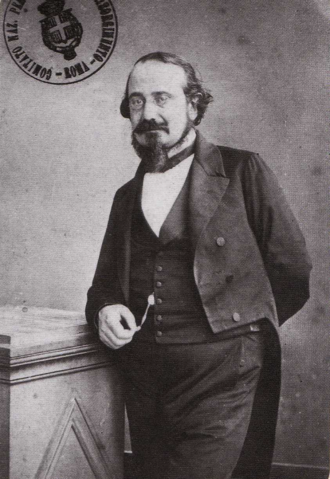
Bertrando Spaventa
1817–1883 · Italian Hegelian philosopher of the 19th century
Bertrando Spaventa (Bomba, 1817 – Naples, 1883) was one of the leading Italian philosophers of the nineteenth century, and also a historian of philosophy, journalist and politician. His Hegelian thinking shaped the intellectual climate of the Italian unification, and through Giovanni Gentile and Benedetto Croce it left a lasting mark on twentieth-century Italian philosophy.
Born into a middle-class family, he trained at the seminary in Chieti and was ordained in 1840, largely for financial reasons rather than vocation. In Naples he taught himself German and English, which let him read foreign philosophers in their own languages, and he founded a private philosophy school with his brother Silvio. After the repeal of the Constitution he had to leave Naples. Having left the priesthood, he settled in Turin, where he wrote for the press and came to engage closely with Hegel. He later held chairs at Modena, Bologna and Naples and served three terms as a deputy.
His most original claim was that modern, secular, idealist philosophy had roots in Italy itself, even though it reached its fullest form in Germany. He blamed Italy's philosophical decline on the loss of intellectual freedom after the Counter-Reformation. His aim was to renew Italian thought without retreating into narrow nationalism. In politics he argued for a strong state as guarantor of civic values, an idea that fed into the later notion of the ethical state.
Key ideas
- Circular movement of philosophy: modern idealist philosophy, in his view, had Italian origins and reached maturity in Germany.
- Critical Hegelianism: engaging seriously with Hegel was, for Spaventa, the way to renew Italian philosophy.
- Intellectual freedom: Italy's philosophical decline, he argued, followed from the loss of freedom after the Counter-Reformation and from despotic rule.
- The ethical state: the state is an organism that gives value to the nation and grounds civic principles.
Books to read
- La filosofia italiana nelle sue relazioni con la filosofia europea ItalianEPUB 317 KBRead online
Original Filopedia text based on Wikipedia (es) and Wikipedia (en) and Wikidata.