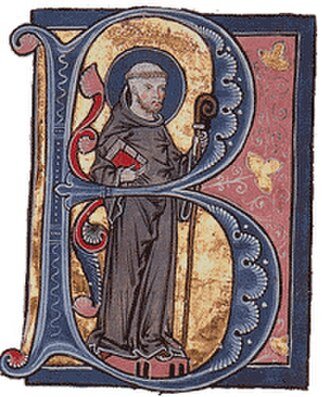
Bernard of Clairvaux
1091–1153 · Cistercian monk and abbot of Clairvaux, a central figure of the twelfth century
Origins and family
Bernard of Fontaine was born in 1090 (some sources give 1091) at the castle of Fontaine-lès-Dijon, in Burgundy. He belonged to the highest nobility of the region: his father, Tescelin de Fontaine, was lord of the place and a knight in the service of the Duke of Burgundy, and his mother, Alèthe de Montbard, came from an equally distinguished family. He was the third of seven children, six of them boys.
Education
At the age of nine he was sent to a school at Châtillon-sur-Seine run by the secular canons of Saint-Vorles. He showed an interest in literature and rhetoric, which he cultivated with energy. During these years of schooling with priests he often thought of becoming one himself. His mother's death, when he was still young, weighed heavily on him.
The choice of Cîteaux
In 1098 Robert of Molesme had founded the abbey of Cîteaux, near Dijon, to live according to a literal reading of the Rule of St Benedict. Its monks set up new administrative structures among their monasteries, which amounted to a new religious order, known after the first abbey as the Cistercians. After his mother died, Bernard decided to join them. In 1113, together with some thirty young Burgundian noblemen, many of them his relatives, he was admitted to the new monastery. His example proved so persuasive that numerous relatives, including his own father, followed him into monastic life, and he is therefore regarded as the patron of religious vocations. According to some accounts, before admitting his companions he had tested their loyalty for six months.
Abbot of Clairvaux
Three years after entering, he was sent with a group of twelve monks to found a new house in the Valley of Absinthe, in the diocese of Langres. On 25 June 1115 he named it Clairvaux, and from then on the names of Bernard and Clairvaux were inseparable. He was ordained priest and blessed as abbot by William of Champeaux, Bishop of Châlons-sur-Marne, a professor of theology and founder of the Abbey of St Victor in Paris, with whom he formed a lasting friendship.
The beginnings were very hard. The rule Bernard imposed was extremely austere, and his own health suffered from the fasting and mortifications he inflicted on himself. The general chapter of Cîteaux had to intervene, and William of Champeaux watched over his condition, to the point that Bernard had to withdraw to a hut used as an infirmary, where healers attended him. Despite this, candidates came in large numbers. In the first ten years three new houses were founded: Trois-Fontaines (1118), Fontenay (1119) and Foigny (1121). During his lifetime more than sixty abbeys followed, some of them new foundations and others transfers to the Cistercian observance.
Preaching, mysticism and the military orders
Bernard was a mystic and is regarded as one of the founders of medieval mysticism. Against the rational method of the scholastics, he preached in a poetic language, appealing to emotion and conversion and seeking a more immediate experience of faith. His preaching strongly encouraged devotion to the Virgin Mary, whom he presented as humble and central to Christian theology. He became known as the
Key ideas
- Mystical knowledge: access to God comes above all through inner experience and love, rather than through discursive reason.
- Primacy of sacred learning: secular knowledge is of little value compared with knowledge of Scripture and faith.
- Love of Christ and Mary: a personal, affective relationship with Christ, and the mediating role of the Virgin, lie at the heart of Christian life.
- Ideal of Christian knighthood: military service in defence of the faith and of pilgrims is legitimate when directed to God's cause.
Books to read
- St. Bernard of Clairvaux's Life of St. Malachy of Armagh EnglishEPUB 345 KBRead online
Curiosities
A honeyed nickname
He was known as the "Doctor Mellifluus" for the smoothness and sweetness of his preaching.
Preaching on foot
He usually travelled on foot, accompanied by a monk who wrote down his dictation along the way.
Teachers and influences
Pupils
- John of Salisbury 1110–1180
Original Filopedia text based on Wikipedia (es) and Wikipedia (en) and Wikidata.