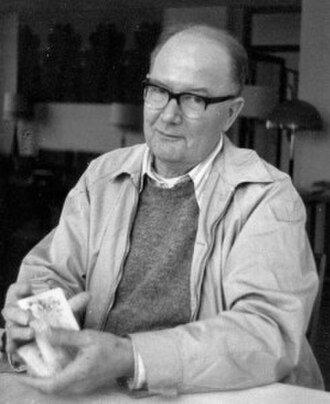
Bernard Lonergan
1904–1984 · Canadian Jesuit theologian and philosopher
Bernard Lonergan (Buckingham, Quebec, 1904 – Pickering, Ontario, 1984) was a Canadian Jesuit priest, theologian and philosopher, regarded by many as one of the most important Catholic thinkers of the twentieth century. Rooted in the Thomist tradition, he sought to renew it so that it could engage modern science, history and hermeneutics.
He entered the Society of Jesus in 1922 and was ordained in 1936. He studied scholastic philosophy in London, where he grew dissatisfied with the Suarezian approach of his teachers, and later theology at the Gregorian University in Rome, where he wrote a doctoral dissertation on grace in Thomas Aquinas. He taught in Montreal, Toronto and Rome, and in his later years at Harvard and Boston College.
His project was to do for his own age what Aquinas had done for his: bring Aristotelian thought into a Christian understanding of the universe, now in dialogue with modern science. The key is self-appropriation, the personal discovery of the dynamic structure of knowing: inquiry, insight, judgment and decision. In Insight (1957) he developed a general account of human understanding; in Method in Theology (1972) he proposed eight functional specialties to organise theological work.
His influence reaches theology, philosophy and economics, and his collected works have been published by the University of Toronto Press.
Key ideas
- Self-appropriation: the personal recognition of one's own intelligence, reasonableness and responsibility as the foundation of all inquiry.
- General method: the pattern of inquiry, insight, judgment and decision that underlies every field of knowledge.
- Renewed Thomism: the aim of updating Aquinas so that he can engage modern science, history and hermeneutics.
- Functional specialties: the division of theology into eight related tasks meant to foster agreement and progress.
Original Filopedia text based on Wikipedia (es) and Wikipedia (en) and Wikidata.