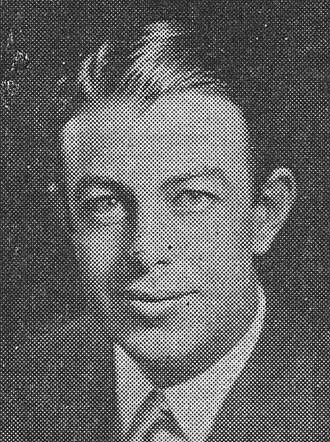
Benjamin Lee Whorf
1897–1941 · American linguist known for linguistic relativity
Benjamin Lee Whorf (1897-1941) was an American linguist best known for arguing that the structure of a language shapes how its speakers perceive and conceptualize the world. He worked within the tradition of American anthropological linguistics, and his name is linked to that of his mentor Edward Sapir in what is called the Sapir-Whorf hypothesis. His thinking draws on ideas from nineteenth-century philosophy, especially those of Wilhelm von Humboldt and Wilhelm Wundt, which is why he is often placed in that intellectual lineage.
Whorf was born in Winthrop, Massachusetts, in 1897, and trained as a chemical engineer at the Massachusetts Institute of Technology. For many years he worked as a fire prevention engineer for an insurance company in Hartford, inspecting factories across New England. His interest in language began around 1924 with the study of Biblical Hebrew, and then shifted to Nahuatl and other Mesoamerican languages. A grant allowed him to study Nahuatl in Mexico in 1930. Later he worked with Sapir at Yale on Hopi and the Uto-Aztecan languages. He died of cancer in 1941, aged 44, and his colleagues gathered and published his manuscripts.
His central claim is that language is not merely a wrapper for thought but a set of habits that guides attention and experience. Whorf illustrated this with examples from his insurance work, such as the "empty" drums that workers handled carelessly because of the name they were given. His strongest version, that language fully determines thought, is now considered too strong, and debate over the scope of his claims continues.
In the 1960s his ideas lost favour because critics considered them hard to test, but interest returned in later decades when scholars reassessed them more carefully. Linguistic relativity remains an active field in psycholinguistics and linguistic anthropology.
Key ideas
- Linguistic relativity: the language we speak influences how we perceive and categorize reality.
- Unconscious linguistic habits: the social group fixes, almost invisibly, the distinctions each person takes as natural.
- Strong and weak versions: Whorf defended a strong thesis that is now accepted only in moderated form, and his legacy survives in these more cautious versions.
- Study of indigenous languages: his work on Nahuatl, Hopi and Uto-Aztecan languages supplied the data behind his ideas.
Curiosities
The "empty" drum
In an example he used himself, workers smoked beside drums labelled empty but not beside full ones, although the empty drums were more dangerous because of flammable vapour.
Insurance engineer
He worked as a fire prevention inspector for a Hartford insurance company while developing his linguistic work.
Teachers and influences
Influenced by
- Wilhelm von Humboldt 1767–1835
Original Filopedia text based on Wikipedia (es) and Wikipedia (en) and Wikidata.