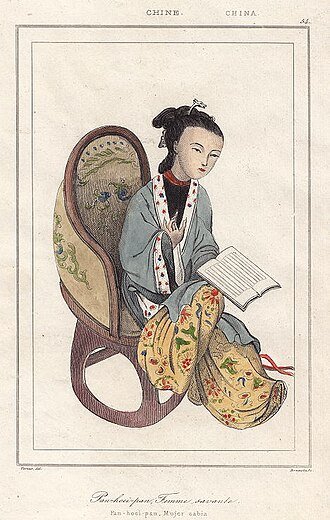
Ban Zhao
45–116 · Chinese writer, historian and intellectual of the Eastern Han dynasty
Ban Zhao (around 45 to 116, though the exact dates are debated) was a Chinese writer, historian and intellectual, and the first known female historian in China. She is remembered for completing a foundational work of history and for writing a treatise on women's conduct that circulated for centuries.
Born in Anling, near modern Xianyang, she was the daughter of the historian Ban Biao and the sister of Ban Gu, author of the Book of Han, and of the general Ban Chao. At fourteen she married Cao Shishu. He died while she was still young, and she never remarried, devoting herself to scholarship instead. Summoned to court, she taught Empress Deng Sui and other members of the court in the royal library, which gave her considerable political influence. As a palace librarian she oversaw the editorial work of a team of assistants and revised and expanded Liu Xiang's collection of biographies of eminent women.
After Ban Gu died in 92, she helped finish the Hanshu, the history of the Western Han dynasty, filling in the missing tables and adding the genealogy of the emperor's mother, information that was not usually recorded. Ma Xu later added a treatise on astronomy. In 113 she accompanied her son Cao Cheng to Chenliu Commandery and wrote an account of the journey, the Dong Zheng Fu, which survives.
Her most influential work, Lessons for Women, advises women to show respect and obedience to their husbands as a way of keeping the family in harmony, within a Confucian and patriarchal order. It also insists that women need a good education. Scholars disagree about how to read it. Some see it as an early form of Confucian feminism, while others regard it as a defence of submission that cannot be reconciled with equality. Much of her writing was lost; her daughter-in-law gathered her works into three volumes, but most have not survived.
Her influence lasted for centuries in China, and she is now remembered as one of the most learned women in Chinese history.
Key ideas
- Women's education: women should receive instruction, though within a hierarchical family order.
- Family harmony: respect for the husband is presented as the way to keep peace in the household.
- Complete history: her continuation of the Hanshu gave dynastic history a fuller and better documented form.
Works in Filopedia
Curiosities
A crater on Venus
A crater on Venus is named after her.
Featured in a literary work
She is depicted in the Wu Shuang Pu (Table of Peerless Heroes) by Jin Guliang.
Original Filopedia text based on Wikipedia (es) and Wikipedia (en) and Wikidata.