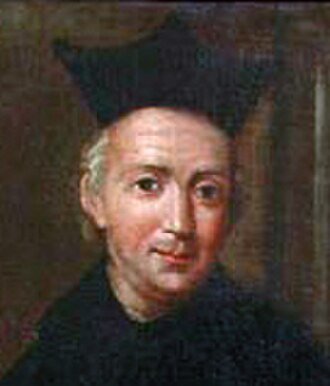
Baltasar Gracián
1601–1658 · Spanish Jesuit priest and Baroque writer
Baltasar Gracián (born in Belmonte de Gracián, 1601; died in Tarazona, 1658) was a Spanish Jesuit priest and writer of the Golden Age. His work belongs to conceptismo, the Baroque style that prized compact, witty expression, and today he is read for his practical wisdom and his gloomy view of human life. Philosophers as different as Schopenhauer and Nietzsche later took an interest in him.
Born near Calatayud in 1601, he was educated within the Society of Jesus. He studied in Calatayud, lived in Toledo with an uncle who was a priest, entered the novitiate in Tarragona in 1619 and was ordained in 1627. He taught in Calatayud, Valencia, Lleida and Gandía, and more than once clashed with his superiors. In Huesca he found a patron in Vincencio Juan de Lastanosa, whose library held nearly seven thousand volumes, and with his help he published his first book, El Héroe, in 1637. Further works followed: El Político (1640), El Discreto (1646) and the Oráculo manual y arte de prudencia (1647), a collection of three hundred maxims on how to get ahead in a difficult world. His treatise on wit, Agudeza y arte de ingenio, appeared in its second version in 1648.
His masterpiece, El Criticón, came out in three parts between 1651 and 1657. It is an allegorical novel in which Critilo, a disillusioned man of the world, and Andrenio, a man of nature, journey through human life from childhood to old age, heading for the Isle of Immortality. Satire of court life and social vices runs alongside a steady moral reflection.
Gracián's thought starts from a Baroque pessimism. The world is deceptive, every thing has a visible surface and a hidden truth, and people are weak and self-interested. His answer is a practical, combative ethics built on prudence, wariness, discretion and the ability to read circumstances. It is less a call to abstract virtue than a guide to getting by among deceptions.
His quarrels with some fellow Jesuits, sharpened by printing books without the order's permission and by the content of his writings, brought him harsh sanctions in 1657. He was sent to Graus and later to Tarazona, where he died in December 1658.
His influence was considerable. He affected French libertine writers such as La Rochefoucauld and, much later, Schopenhauer and Nietzsche. In the twentieth century he came to be seen as a forerunner of existentialist sensibility, though his work is best read against the background of a declining Spain.
Key ideas
- Baroque pessimism: the world is deceptive, and appearances often win out over truth and virtue.
- Prudence and wariness: to survive in social life one must observe, calculate and trust few people.
- Discretion and adaptation: knowing how to behave according to the occasion is a necessary skill.
- Conceptismo: wit and brevity, with wordplay and sharp insights, as a way of saying much in few words.
Books to read
- El criticón (tomo 1 de 2) SpanishEPUB 362 KBRead online
- El criticón (tomo 2 de 2) SpanishEPUB 369 KBRead online
Curiosities
Schopenhauer and El Discreto
Schopenhauer translated El Discreto into German and regarded it as a book for lifelong use, a companion for anyone who wished to prosper in the wider world.
A letter from Hell
From the pulpit he delivered striking oratorical pieces, such as a letter supposedly sent from Hell, which his superiors viewed with disapproval.
Churchill and Jacobs's translation
Winston Churchill is said to have read Joseph Jacobs's English translation on the ship that carried him to the Boer War, though the claim is not firmly documented.
Teachers and influences
Influenced
- Friedrich Nietzsche 1844–1900
Original Filopedia text based on Wikipedia (es) and Wikipedia (en) and Wikidata.