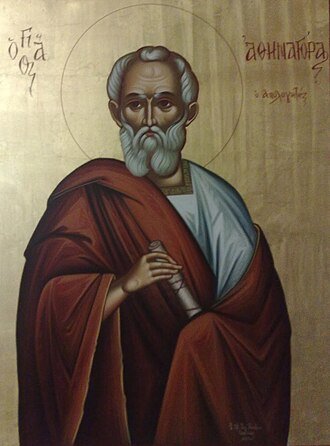
Athenagoras of Athens
· Athenian philosopher and Christian apologist of the 2nd century
Athenagoras of Athens was an Athenian philosopher who converted to Christianity and wrote in the second half of the 2nd century, during the period of the so-called apologists, authors who defended the Christian faith before pagan society and imperial power. Little is known about his life with certainty. He was Athenian, he had a philosophical education, and he embraced Christianity. He calls himself "Athenagoras, the Athenian, philosopher, and Christian" in his writings. Some later sources place him at the head of the catechetical school of Alexandria, though this claim is probably mistaken.
Only two of his works survive: the "Embassy for the Christians", often called the "Apology" or "Legatio", and the treatise "On the Resurrection of the Dead". The Embassy, dated to around 177 or 178, was addressed to the emperors Marcus Aurelius and Commodus to plead for fair treatment of Christians, who were accused of atheism, cannibalism and incest. Athenagoras answers each charge with calm, carefully built reasoning, and he chooses a courteous tone that avoids giving offence to those in power. His style is sober and precise, and he shows a more sympathetic attitude toward Greek philosophy than some of his contemporaries did.
In theology, Athenagoras defends the unity of God against pagan polytheism. He relies on speculative argument, and his favourite proof is the order of the world: the beauty and regularity of the cosmos point to a Creator, just as a ship needs a pilot. He also expresses faith in the Trinity more clearly than many writers of his century, speaking of the Father, the Son as the Word of God, and the Holy Spirit. In the treatise on the resurrection, written after the Embassy, he argues that God can raise the dead and that human nature calls for the continuation of body and soul, while the soul remains unconscious between death and resurrection.
His influence on later Christian thought was considerable, above all for his attempt to express the faith with the resources of Greek philosophy. His argument from the order of the world was repeated by later apologists, and his defence of the Trinity anticipates debates that would reach the councils. Though he is less remembered today than some of his contemporaries, his writings show how early Christian thinkers sought a place within the philosophical culture of their age.
Key ideas
- Unity of God: against pagan polytheism, he holds that there is one God, uncreated, eternal and incomprehensible in essence.
- The argument from order: the order and beauty of the world reveal a Creator who governs it, as a ship needs a pilot.
- Word and Son: the Son is the Word of the Father, proceeding from God and eternal with him, not created out of nothing.
- Trinity: the Father, the Son and the Holy Spirit show a unity of power with a distinction of persons.
- Resurrection of the dead: the body can rise by the power of the Creator, and human nature calls for the continuation of both body and soul.
Teachers and influences
Pupils
- Clement of Alexandria 150–215
Original Filopedia text based on Wikipedia (es) and Wikipedia (en) and Wikidata.