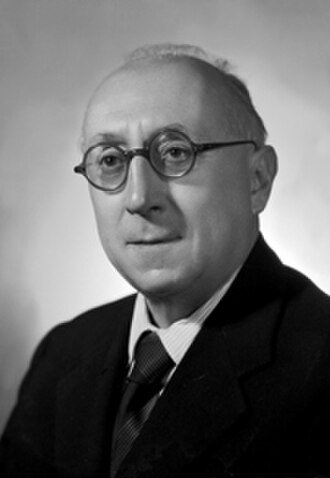
Antonio Banfi
1886–1957 · Italian philosopher, aesthetician and politician, founder of critical rationalism
Antonio Banfi (Vimercate, 1886 – Milan, 1957) was an Italian philosopher, aesthetician and politician, best known for founding critical rationalism, a school that sought to join experience and reason from a non-dogmatic standpoint. Trained in Milan and Berlin, he moved away from the idealism dominant in Italy and turned towards Marxism, particularly historical materialism.
After teaching in secondary schools, he gained the chair of History of Philosophy at the University of Milan in 1931, where he also taught aesthetics. In 1940 he founded the journal Studi filosofici, which spread his ideas. During the Second World War he joined the resistance and drew closer to the Communist Party. He became a senator in 1948 and was re-elected in 1953.
His main work, Principi di una teoria della ragione (1926), examines the relationship between philosophy and historicity and criticises any metaphysics of knowledge. His aesthetic studies, later gathered in Filosofia dell'arte, and his work on Galileo show a broad interest in culture. His influence can be seen in pupils such as Dino Formaggio and Rossana Rossanda.
Key ideas
- Critical rationalism: the integration of experience and reason from a non-dogmatic standpoint.
- Philosophy of culture: thought as the analysis of concrete knowledge and history.
- Critique of metaphysics of knowledge: rejection of absolute foundations that ignore historicity.
- Ethics of historical commitment: action in reality as a form of moral responsibility.
Original Filopedia text based on Wikipedia (es) and Wikipedia (en) and Wikidata.