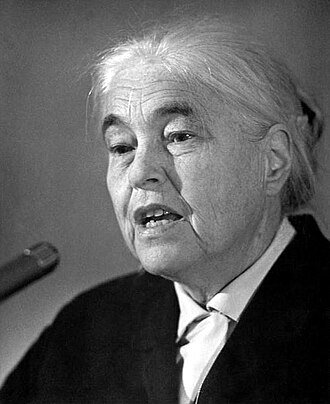
Anna Seghers, born Netty Reiling in Mainz in 1900 and died in Berlin in 1983, was a German writer whose work spans the interwar years, the anti-fascist exile and the founding of the German Democratic Republic. She is remembered for her attention to the moral experience of the Second World War and holds a central place in German-language exile literature.
She came from a Jewish family and her father, Isidor Reiling, dealt in antiques and cultural objects. She studied history, art history and sinology at Cologne and Heidelberg, and in 1924 completed a doctorate at Heidelberg with a thesis on Jews and Judaism in the work of Rembrandt. That year she published her first book, Revolt of the Fishermen of Santa Barbara, under the pen name Anna Seghers, which is believed to derive from the Dutch painter Hercules Segers, though this remains a widely held hypothesis rather than a confirmed fact. In 1925 she married the Hungarian sociologist László Radványi, and in 1928 she joined the German Communist Party. Her first novel won the Kleist Prize that same year, and from then on her literary and political life was closely tied to the left.
The rise of the Nazis transformed her circumstances. She was briefly detained by the Gestapo, her books were banned and burned, and in 1933 she went into exile, first to Switzerland and then to Paris. During the war her husband was interned at Le Vernet, and she escaped with her children to southern France, where, from Marseille, she obtained a visa and passage to Mexico. The months of waiting there formed the basis of Transit, published in 1944. In Mexico City she founded the anti-fascist Heinrich Heine Club and wrote The Seventh Cross, published in English in 1942, about seven prisoners escaping a Nazi concentration camp. It became her best-known work, and Fred Zinnemann's 1944 film adaptation brought it to a wide international audience.
In 1947 she returned to Germany and settled in Berlin, first in the western sector and later in the Soviet zone, where she became a central figure in the cultural life of the GDR. She chaired the GDR Writers' Association from 1952 to 1978 and helped to found the Academy of Arts of the GDR. Her later works, closer to socialist realism, have been received with mixed critical views, and her relationship to the regime remains a subject of debate. Her legacy endures in exile literature, in the memory of the Second World War, and in the museum dedicated to her life and work in her former Berlin-Adlershof home.
Key works
- Revolt of the Fishermen of Santa Barbara (1928), her first novel, portraying a fishing community in conflict.
- The Seventh Cross (1942), about seven prisoners escaping a Nazi concentration camp.
- Transit (1944), a novel about refugees waiting in Marseille.
- The Excursion of the Dead Girls (1943), an autobiographical story about a school outing and the fates of its pupils.
- The Decision (1959), a novel from her years in the GDR.
Works in Filopedia
- The Seventh Cross 1942
Curiosities
A pen name
Her pseudonym is believed, according to a widely held hypothesis, to derive from the Dutch painter Hercules Segers, though this is not fully confirmed.
A novel brought to the screen
The 1944 film of The Seventh Cross, directed by Fred Zinnemann and starring Spencer Tracy, made her known around the world.
Original Filopedia text based on Wikipedia (es) and Wikipedia (en) and Wikidata.